
Creators across disciplines often argue that constraints give their work its creative force. Among the many forms constraint can take, technical limitation is perhaps the most familiar. Looking at graphic design from the pre–personal computer era, I'm often struck by this. The process was slower, more demanding, and far less democratised. Yet the results often feel more assured than much contemporary work produced under conditions of vastly greater technical freedom.

One such design caught my eye on the cover of a map while I browsed the shelves of Nagamori Shoten in Jinbōchō. Hand-laid type sat over a sakura-patterned wheel on a red background, graduating to blue, perhaps through paints, inks, or pigments. The combined effect of printing method, paper, and ageing is something designers might now spend hours attempting to reproduce with digital effects and filters, or approximate through specialist printers. The title read: Tourist Map of Tokyo.

Nagamori Shoten is a remarkable repository of historical maps, photographs, and transport timetables. Much of the material is kept in protective packaging, which discourages casual handling, so I bought the map for its cover alone—possibly the first time I have judged a map by its cover. I left the shop assuming it dated from the Shōwa era, likely the 1950s or 60s, and stored it away on my return to London.

When I finally opened it this week, the quality of the design stunned me: coral and beige layers printed with evenness; crisp red, white, and black lines marking streets and waterways; a judicious use of bright grass green for parks and open spaces; painstaking typography; and a restrained measure of ornamentation.
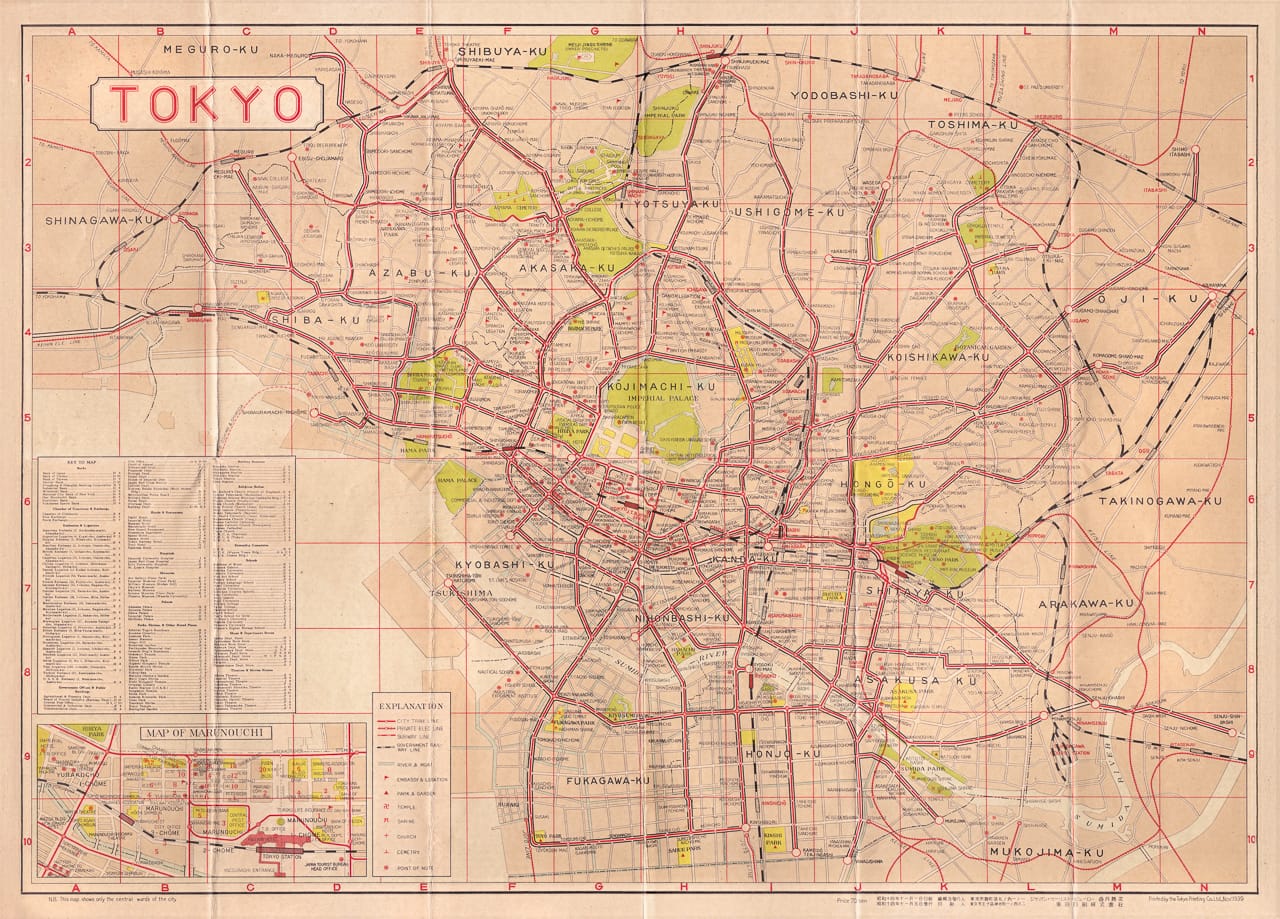
Next, it became clear that the map predates the 1947 reorganisation of Tokyo’s wards, indicated by the presence of now-dissolved districts such as Takinogawa-ku, Yodobashi-ku, and Yotsuya-ku. West is placed at the top, deprioritising Shibuya while expanding eastern shitamachi areas such as Fukagawa. A final surprise appeared in a line of mouse-type at the lower right: Printed by the Tokyo Printing Co. Ltd., Nov. 1939.

November 1939 was a period of global churn. War was already under way in Europe, and Japan was deep into its own phase of imperial expansion and rising militarism. What kind of English-language tourist guide could Tokyo have produced at such a moment? Embassies, banks, and churches sit alongside theatres and museums in the map key, offering a clue. The full answer appears on the reverse.

Flipping the map reveals dense columns of text, favouring information over illustration. An introductory paragraph of formal, institutional prose sets the tone:

Tokyo, being the capital of the Empire, naturally has many things that will appeal to the eyes of foreign travellers. They would do well to stay here several days and study Japanese civilization epitomised in this metropolis of about six and one half million people, which ranks second largest city in the world.

The first few columns foreground hotels, “dainty dishes”, and fine goods. Botanical gardens, memorial halls, and imperial parks appear among the listed places of interest. Even motor-car excursions, seasonal flowers, and golf courses are treated as categories in their own right.

The likely user of the map begins to suggest itself. It appears to be an educated Western visitor, probably arriving by ship—perhaps aboard an NYK Line vessel such as Hikawa Maru, launched in 1930 for Japan–North America routes. From the port, which is plotted on the map, a pattern of movement emerges: international hotels, formal gardens, performances, museums, embassies. The map seems calibrated for visitors whose presence carried institutional or professional weight—those engaged in observing, reporting on, or negotiating with the city.

The layout reflects policy currents that emerged after the unequal treaties imposed on Japan in 1858. These agreements limited Japan’s sovereignty through fixed tariffs, legal and commercial advantages granted to Western powers, and extraterritoriality, which placed foreign residents beyond Japanese law. In the decades that followed, Japan pursued legal reform, diplomatic negotiation, military modernisation, and institutional development in an effort to remove these constraints.

Tourism, then, became one of the means by which these reforms were made visible and operative. English-language guidebooks, upgraded hotels, professional interpreters, and indeed, purpose-designed maps formed part of this effort. Together, they contributed to the project of building Japan as a modern state through legal, cultural, and urban development.

By the early twentieth century, this approach was well established. Even after the ultimate abolition of extraterritoriality in 1899, inbound tourism persisted. Under the economic pressures of the 1920s and 30s, it acquired new weight, becoming a source of revenue and international recognition and, by 1936, reportedly ranking as Japan’s fourth-largest source of foreign exchange. Promotion offices were established in cities such as New York, London, and Paris, while the Japan Tourist Bureau produced materials portraying Tokyo as a stable, cultured, and internationally engaged city.

This confidence finds expression in the 1939 map. The Imperial Palace sits at the centre, both cartographically and symbolically. Around it, the city resolves into a familiar institutional grammar of financial districts, civic halls, embassies, and cultural venues. The parks, museums, theatres, and universities appear as everyday features of the capital, and even churches are given conspicuous prominence—an emphasis rarely found in contemporary Tokyo guides. Japan’s modernity is presented as a given.

While much of the surrounding city was erased by firebombing, elements of the prewar architecture recorded on the map remain intact. The Bank of Japan’s main building, completed in 1896, remains a fixed point in Nihonbashi, as it was in 1939. Hibiya Public Hall, opened in 1929, is one of the few surviving prewar civic auditoriums still standing in its original location. The National Diet Building, completed only three years before the map was printed, continues to occupy the same symbolic position within the city. Together, these buildings preserve the institutional form of the prewar capital, allowing the 1939 map to be read as a guide to sites that either survive intact or remain fixed in place despite subsequent architectural replacement.

To that end, we’ve laid out the 1939 map on a custom Google Map, which is free to view.

Followed today, the map guides you largely away from contemporary tourist concentrations and towards points of continuity. Formed amid the turbulence of its own time, it reappears in 2026 as a disciplined and sophisticated way of seeing Tokyo—a counterpoint to the consumption-led, icon-driven logic of most contemporary tourist maps. As spectacle and consumption increasingly dominate travel culture, it leads instead towards a Tokyo defined by endurance, attention, and depth. That many of the sites it directs us to are now lightly visited heightens the contrast, and explains why the 1939 map remains worth following.

Until we meet in a slower Tokyo,

AJ


If you like exploring cities via deep context, maps and milestones, approximately fifty copies of Tokyothèque Neighbourhoods Vol. 1 remain. There’s no manufactured urgency here: given the positive feedback we’ve received, a second pressing will follow, though it will not be numbered, signed, or sealed. What we’ve learned through the end-to-end process of printing in Japan and distributing the book internationally means the next edition will also be priced slightly higher.

If it has been on your mind to pick up a copy, now might be the moment.

P.S. To any European readers waiting for delayed deliveries: we encountered a few customs issues and now have a strategy to resolve them. So fear not, I’ll be in touch with you soon.

A Long View of Tokyo