
Small white rectangles fill the viewfinder. Faint vertical seams divide the surface into larger panels. A white pole stands against the grid, carrying a red no-entry sign that forms the scene’s only circular note of colour. A diagonal handrail cuts across the composition. Around it, a wall-mounted lamp, three deep rectangular openings and two folded recycling crates in blue and yellow guide the eye across the frame. I click the shutter and lower my camera.

Standing in the near silence of the afternoon, I consider whether to study the scene further through different framings, angles and focal lengths. But looking up at the apartment building these tiles belong to, I feel no urgency. I got the shot in one. A bicycle passes, its bell ringing, as a kei truck turns the corner. The neighbourhood seems to agree. It is time to keep walking.

Apartment buildings continue to appear, each clad in a variation of tile. Their surfaces share a general character, though colour, orientation, arrangement and proportion distinguish one from the next. The building I have just photographed uses 45-Nichō (45二丁), a compact rectangular tile measuring 95 × 45 mm, laid vertically. It became a familiar feature of Japanese neighbourhoods after its widespread adoption for mansion and apartment buildings from the late Shōwa period through the Heisei period. You might say that it now carries something of a Heisei-retro aesthetic.
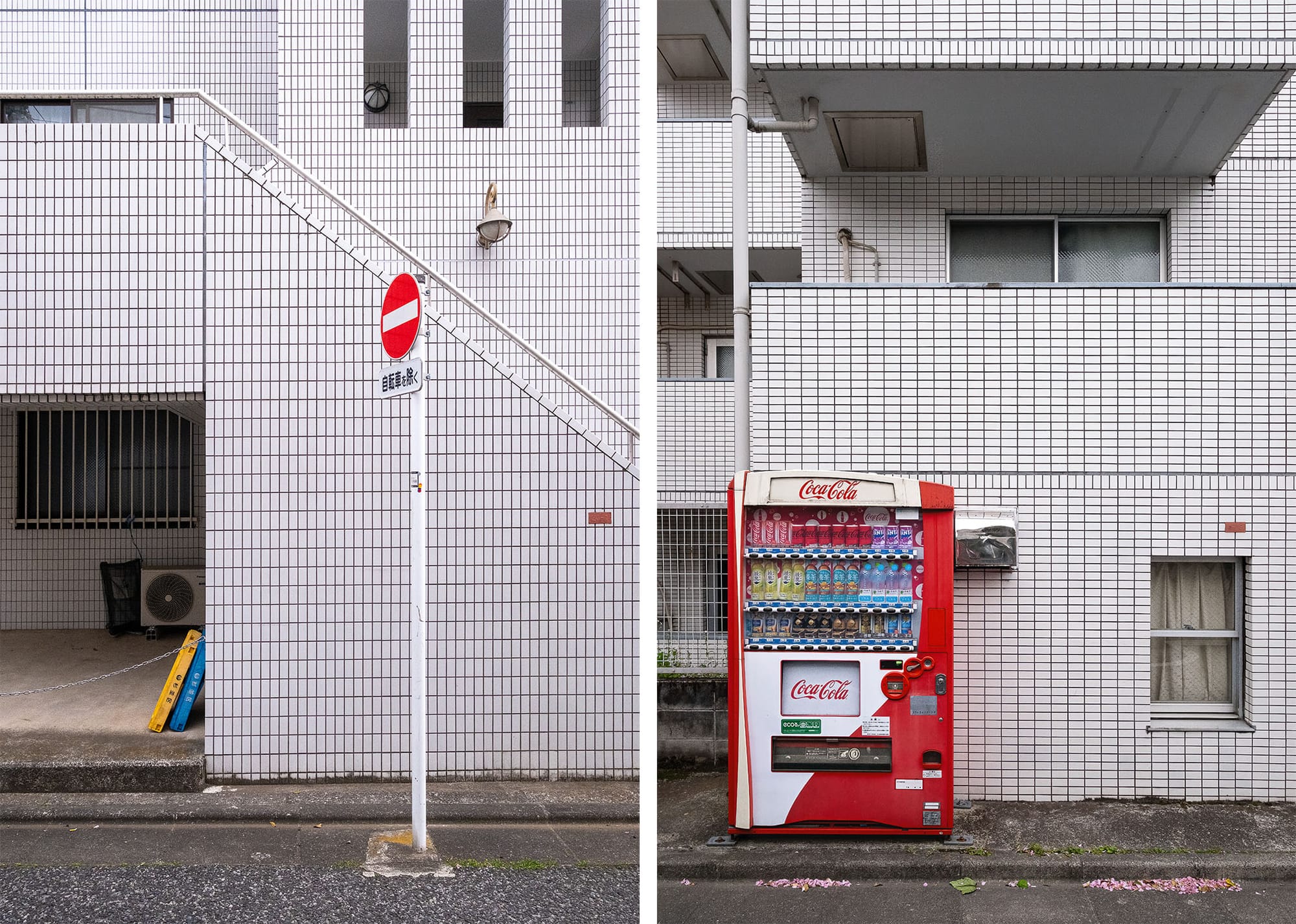
45-Nichō In Situ

One building is clad in tiny white squares with near-total regularity. A small tree rises from a narrow planter and crosses a barred window, as though trained to the grid like a bonsai. Similar disruptions recur throughout the neighbourhood: a bicycle leaning out of place, laundry drying in the afternoon sun, cables slung low and bric-a-brac stacked high.

In cities with more remaining period houses than Tokyo, the architecture already speaks with a strong voice. The historical character of the buildings tends to outweigh the personal touches of those who live there. But here, the unopinionated, diagrammatic grid recedes into the background, allowing those touches to become the voice. The neighbourhood’s personality wraps itself around the plainness.

I take one step to the left and raise the camera. The tiled grid provides a backdrop to compose against. Through the viewfinder, I square the image, follow the lines and watch the neighbourhood’s disparate elements align. Framing such scenes brings a similar order to my mind—a directly accessible flow state. I let the rest of the street fall away and click the shutter again.

Green Disrupts Grids

The use of architectural tile in Japan began with the completion of Tokyo Station’s Marunouchi building in 1914. Indeed, although commonly described as red-brick, its exterior walls are clad in tile. German machinery was imported to produce the decorative bricks, which were manufactured domestically using the dry-press method, a leading technology at the time.

The same technology later produced 45-Nichō and related tiles. They are resistant to dirt and rain, easy to maintain, do not need repainting and are highly durable. These qualities fostered a lasting belief that tile-clad exterior walls were reassuring. I feel it too in the economical, repeatable array of catalogue choices: a rational system for an irrational world.

I compare the effect of these scenes with that of monumental architecture. On a recent trip to Brussels I stood before the Hôtel de Ville, a work of Brabantine Gothic grandeur. I recognised the skill, power and religious intent expressed in its architecture. Yet I did not take a photograph. Its ornate detail impressed me but did not settle me. I was more drawn to the city's ordinary brick houses. Repetitive, weathered and human-scaled, they did not ask to be admired in the same way, leaving room for meaning to arise rather than declaring it.

The afternoon is growing long in Tokyo. I turn onto a narrow shopping street and see a rectangular apartment façade divided into rows of warm brown tiles and dark horizontal joints. Sunlight strikes it from the side, turning parts of the grid copper-orange while the lower section remains in heavy shadow. An air-conditioning unit breaks the surface with its circular fan grille and pale metal casing. The building expresses no architectural manifesto. It reflects cost control, weather resistance and standardisation. Yet when the late sun enters the equation, it takes on a mathematical beauty. I perch on the curb, press my back against the opposite wall to straighten the converging verticals and click the shutter again.

I am not much of a thrill-seeker. I travel often, camera in hand, but rarely in pursuit of excitement or spectacle. Some may find that uninteresting, but I have grown comfortable with the knowledge that my preferences sit outside the mainstream. It is easy to drift with the current of the crowd, uncertain of one’s self. With each year, however, my instincts accrete like a coral reef rock. For those who feel small things acutely and think in visual and spatial terms, boredom is almost impossible.

Cloud passes overhead. In an instant, the golden light on the apartment building turns neutral grey, and the vivid shadows dissipate into an even wash. I step down from the curb and continue walking. The composition falls apart behind me as though it had never existed.

Those moments of alignment in the viewfinder are always brief. Even the flow state produced by their accumulation must end. I can remain there for a long time, though not indefinitely; once entered, it carries the mind until the body asks to return. And so, I set a course for the station, mentally reset. The photographs are what remain: the sawdust of self-work.

Until we align in Tokyo,

AJ


The photographs in today’s newsletter belong to Fleeting Alignments, a new series of photographic prints developed through restorative photo walks like this one. Eight images are available as framed or unframed prints in three sizes, each limited to an edition of 100.

They offer a window into Tokyo for the home or workplace and, perhaps, a way back into that temporary flow state.

Grid Therapy