
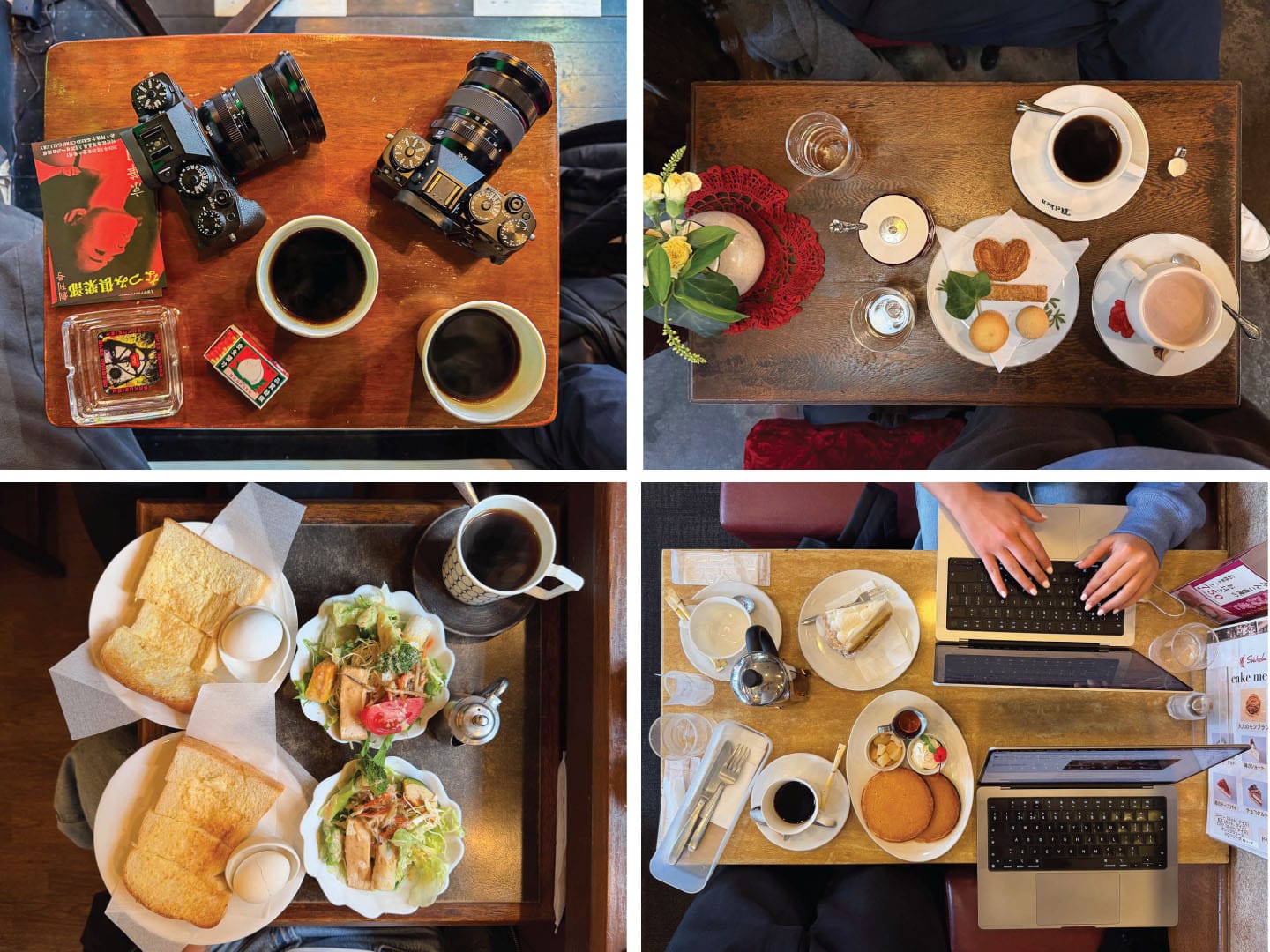
Our neighbourhood mapping method centres on walking the streets and experiencing the city viscerally. Each route we design is joined by a series of milestones: outdoor shopping streets, shrines, and parks, certainly, but also coffee shops, cafés, and restaurants. Consequently, we have spent perhaps as much time within Tokyo’s interiors as on its streets during the past week’s research.

In the process, we’ve found ourselves drawn to independent, owner-operated establishments. These are lived-in spaces, built slowly, often over decades. They tend to occupy small footprints, yet are deeply imbued with character. It is a form of intimacy in which this city excels.

Last week’s newsletter concluded with the suggestion of doors waiting to be opened. We have been busy doing just that, and we return this week with some of our impressions of what we have found inside.

Visions of a neon-lit utopia and the relentless energy of its pop culture notwithstanding, Japan’s most enduring external projection remains, perhaps, the Zen void. This is export Japan: rock gardens and ink-wash scrolls, a landscape of off-white expanses and fastidiously placed monochromatic elements. It is also the version of the country the average citizen may intersect with least in the course of daily life.

The range of spaces we’ve entered this week reveals a city that resists a vacuum, where any void is reflexively filled. Stepping inside is less a transaction than an entry into the wild overgrowth of an owner’s mind. Here we find Japan as it is lived: abundant, idiosyncratic, and inherently opposed to decluttering.

Below are three such interiors encountered this week within the Asagaya neighbourhood.

The first space is a meikyoku kissa, a café dedicated to the appreciation of classical music. The exacting proprietor was not content to stop at a symmetrical wall of horn speakers; instead, listeners are cocooned by an assembly of paintings, clocks, lamps, and various ornaments. The texture of the past is palpable in the furnishings, which have been amassed over fifty-six years. Pristine as the sound from the hand-built system may be, the room itself competes for attention.

The second is a café with an adjoining gallery secreted away above a barber shop. It represents a collision between the midcentury American diner and the contemporary Japanese underground. A Trevor Brown tarot poster in conversation with a neon Coca-Cola sign suggests a chaotic-neutral sensibility nourished by the aesthetics of defiance. The owner’s vision is a loud, unabashed collage of global influences filtered through a local, rebellious lens.

Finally, there is the coffee shop and curry restaurant of a gentle renaissance man. Every element of the sensory experience has been crafted by his hand: the paintings on the walls, the ghostly electric guitar music drifting from the speakers, and the very curry on the plate. Notice the dried flowers, the salt lamp, the mismatched ceramics lining the shelves. It is a life made by hand—domestic and tender with a certain efficiency in its coziness.

Each space captures a distinct variety of psychological overgrowth. It is this masterclass in character and maximalism I find myself increasingly drawn to with each trip back to Japan. The minimalism prized by the global aesthetic functions on one hand as a genuine expression of a highly refined cultural zone, but also as a sterile abstraction that bears little resemblance to the lived reality of Tokyo.

Across the table, Kiara was already looking past the visual density toward a different question: what does it actually mean to collect?

The act of collecting runs deeper than the simple acquisition of items. Over time, objects diverge from their functional use, and come to exist as extensions of their owner. The relationship develops to the point that the object’s value depends almost entirely on the owner’s emotional connection to it.

We began one morning with this thought at Gion, a kissaten across from the east exit of Asagaya station. Its interior, an antique dream of Tiffany-style lamps and French upholstery, led us to question how it was assembled. The room felt transportive, offering entry into the owner’s corner of the world. We wondered whether it had been furnished in its entirety from the outset. 

Gion exemplifies a particular kissaten experience. Spaces like these are contained in two senses. First, physically: a remarkable number of objects condensed into often tiny rooms. Second, figuratively: they exist apart from the order of public life, allowing the owner’s taste to run free within its bounds. 

As we finished our morning set, the master approached our table and started a conversation. We learnt a little about how his collection came to be. Beginning with just a single record, he collected each lamp, cup and chair over fifty years. 

The collection could be seen as a response to the irreversibility of time. In this light, collecting does not so much negate temporality as reorganise it. Time can be structured and manipulated by way of tending to the collection. Each new possession becomes a point of renewal in that every existing object is reinterpreted in relation to it. 

This systematic approach to collecting may create the sense of controlling time, or perhaps more simply coping with its passage. Seated within the master's universe, this feeling extends to our experience as customers. As AJ suggested, we may have surrendered as much time to these enclosed worlds as to the city streets that lead to them.

AJ & Kiara

We’re currently in Tokyo laying the groundwork for Tokyothèque Neighbourhoods: Volume Two. Each edition focuses on a specific selection of districts, curated through rigorous exploration. We walk each street to design comprehensive routes, offering a level of depth and urban detail intended for those who prefer to see the city with intention.

While our focus is on the upcoming volume, Volume One remains available for those ready to start their collection. It serves as a definitive guide to the architectural layers of Daikanyama, the storied bookshops of Jinbōchō, the French-inflected geisha districts of Kagurazaka, and the creative enclave of Nishi-Ogikubo

PS: For those who have spent time with Volume One, we’ve opened a brief survey. If you’d like to contribute to the evolution of the series, your perspective would be invaluable in refining Volume Two.

Interior Worlds

April in Tokyo: Week Two