
Viewed from above on a hazy day, the Tokyo skyline might be described as lacking colour. Buildings clad in muted tones and glazed façades reflecting the overcast city sky form a baseline palette of greys. Infrastructural concrete and metals concur. Even on clear afternoons, when the sun casts warmer light across the city, the urban field only just shifts into beige.
Research suggests this view is widely held. The specialty chemicals company Lanxess, which supplies pigments and additives for the built environment, surveyed over 1,000 Tokyo residents, finding that 60% perceive the city as grey. Black and white followed, with colour appearing only marginally in responses naming blue.
But what we call ‘grey’ is less a colour than a condition in which no single hue asserts itself. It appears where many tones are present but none dominates—where surfaces scatter light without allowing any one wavelength to prevail. A similar flattening occurs when a city like Tokyo is perceived as grey.
Over time, I’ve photographed a collection of cladding from ordinary Tokyo apartment and office buildings. Take these representative samples:
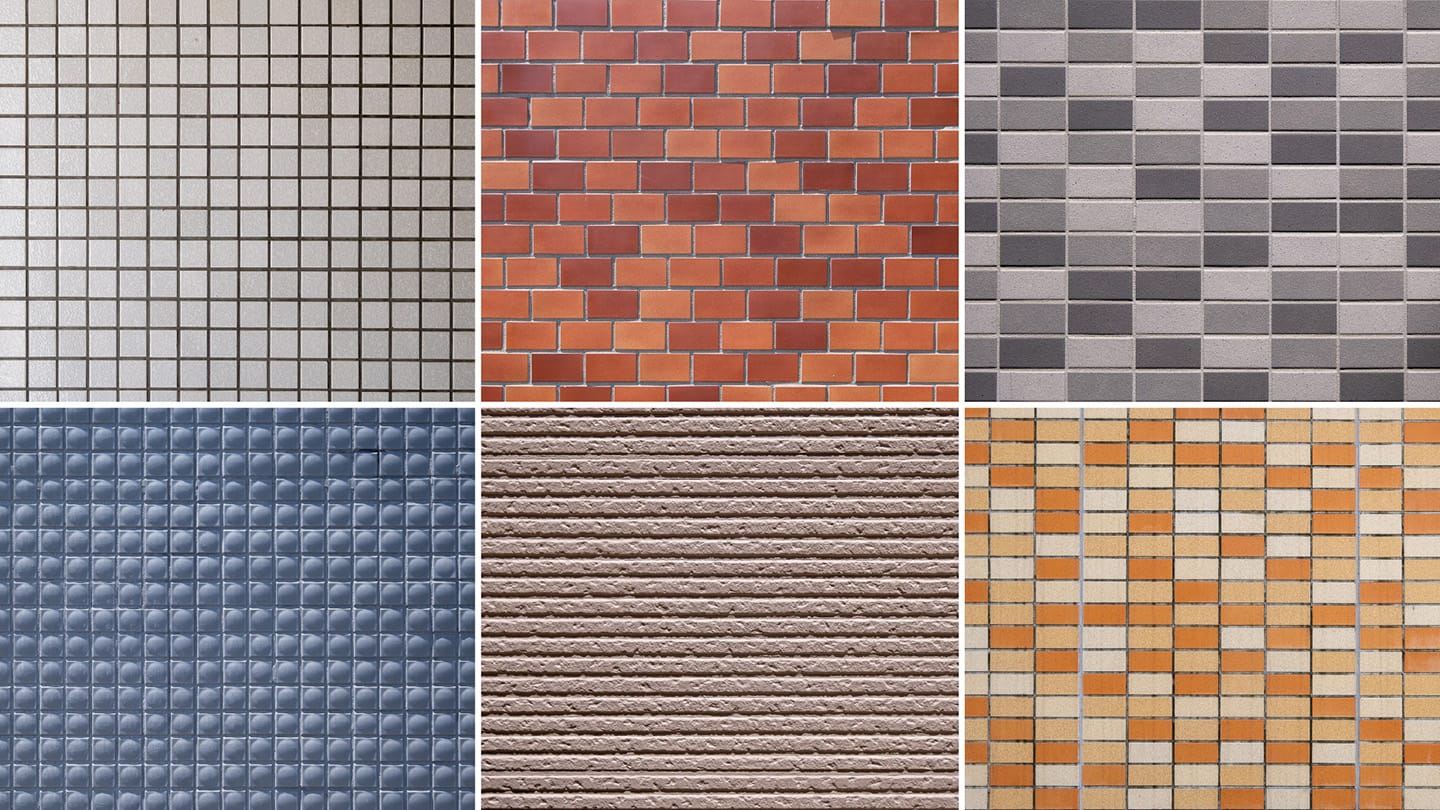
There is little true grey amongst them, but with a slight squint, the image held by 60% of respondents becomes understandable. Still, even if these surface materials, taken together from a distance, seem to support it, I do not perceive the city as a bland, indistinguishable mass. To me, Tokyo is anything but grey.
Neighbourhood Synaesthesia
So far, we have been treating colour as something the eye registers. There is also, however, colour as it exists in the mind, assembled from memory, association, and prior experience. It is this mental construction that holds my interest, having grown to understand that I live with a degree of synaesthesia.
Synaesthesia is a neurological phenomenon in which stimulated senses trigger involuntary experiences in others, such as tasting words, seeing colours with music, or feeling touch when witnessing it. In my internal world, the letter A is invariably red, an instance of grapheme–colour synaesthesia. Meanwhile an F-sharp minor chord played on the piano appears as purple, a form of sound–colour association known as chromesthesia.
Several theories address why synaesthesia occurs, though none fully accounts for it. It is often described as ‘cross-talk’ between sensory regions of the brain, linked to heightened connectivity in early development.
Some forms may also arise at a conceptual level—the letter A might “feel” red through learned association. This begins to suggest why colour, for me, attaches not only to sounds and words, but to people and, indeed, places as well. Whether wholly attributable to synaesthesia or not, cities resolve into distinct palettes in my mind. This perception settles at that familiar unit of human-scale legibility—by neighbourhood.
Testing myself, I mapped several Tokyo neighbourhoods to colour:
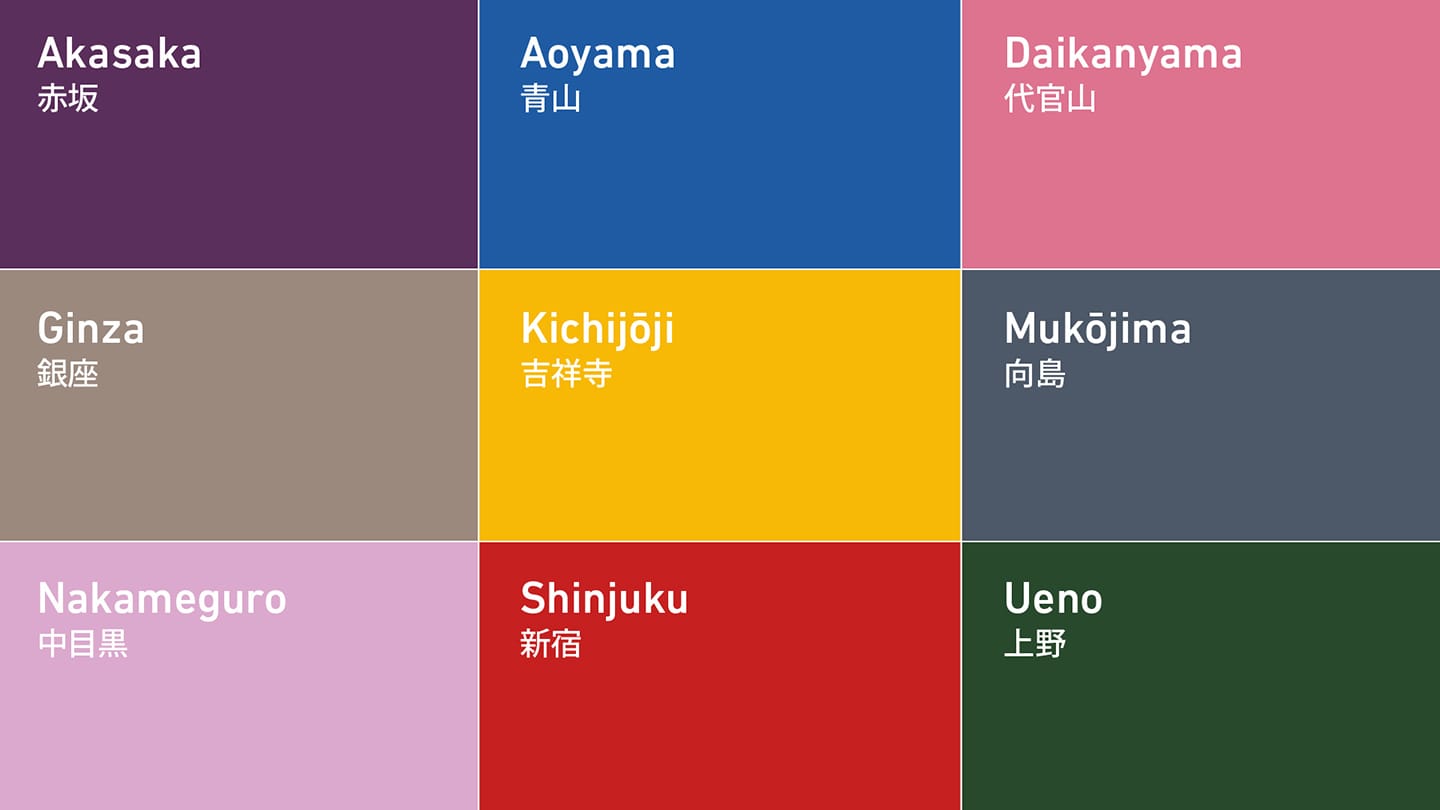
Here, I bind the abstract entity of the neighbourhood to a stable percept—colours translated into the closest RGB values I could reach with the colour picker. It is a brutal flattening of a far richer perceptual field, but it serves illustrative purposes.
Some of these colours make immediate sense to me; others call for closer attention. In either case, they offer an entry point into the finer grain of colour that composes the city beyond the perception of grey.
Graphic Systems
From Harry Beck’s 1933 London Underground map, through Massimo Vignelli’s 1972 New York Subway diagram, to Tokyo’s integrated graphic system as it took form from the late 1980s into the 1990s—the colour-coded transit map is typically the means by which a city visitor first locates a neighbourhood.
If you navigate to Kichijōji for the first time, as I did, finding it on the JR Chūō-Sobu Line's route map, it might be difficult to shake off the notion of the place as bright yellow. I don’t see every neighbourhood on the line as yellow in this way, but Kichijoji is stable in its canary hue. The association begins as a graphic one, yet finds correspondence in the everyday warmth of the place.
Shinjuku, too, appears to hold a 1:1 relationship with Tokyo Metro’s transit graphics. Although eleven technicolour lines converge at the station, my years of commuting on the Marunouchi Line seem to fix its association as red. This kind of colour-coded correlation is not a given, yet it forms one strand in the mesh from which a neighbourhood palette begins to emerge.
Tinted Toponyms
Many Tokyo district names carry colour within their kanji etymology. Akasaka combines red (赤, aka) and slope (坂, saka); Meguro, eye (目, me) and black (黒, kuro). Two places on my grid correspond directly: Ginza—its name deriving from silver (銀, gin) and a historical “seat” or guild (座, za)—and Aoyama, blue (青, ao) and mountain (山, yama). Learning kanji alongside navigating Tokyo might have fused these associations into the neighbourhoods themselves.
Still, in some of the less explicable cases, the reaction seems to arise from the name on the page itself. It is a form of lexical–colour synaesthesia in which whole words or concepts trigger colour directly. I have no clear account of why Daikanyama should register as a warm pink, but I suspect the account doesn't exist to be found. Seen in either Japanese or Roman script, it remains fixed as such—the word arriving already coloured, before memory or association has time to attach.
Urban Environment
Akasaka, despite its meaning of ‘red slope’, has never registered as red for me. The brain's synaesthetic truth here overrules the literal linguistic truth. My sense of the area draws instead, I think, on its history as a geisha district—still true in certain closed-door establishments. At night, these sit within a wider mosaic of cocktail bars on the upper floors of zakkyo buildings and jazz bars below street level. Taken together, Akasaka settles into a deep, velveteen purple.
Mukōjima, a compact neighbourhood on the east side of the Sumida, just north of Skytree, carries a lesser-known but comparable history. This places it in a similar range of lightness and saturation for me, though the choppy presence of the Sumida River draws the hue towards slate blue. Ueno, by contrast, appears as a dark green—perhaps a composite of parkland, low city history, and a hint of Yamanote Line green.
These mental palettes I do not take to be mere imaginings; they are traces of the city’s history and the energy of its present, invisible from a distance but rich in colour up close.
To the eye, perhaps Tokyo’s skyline is grey at certain moments—the familiar ‘concrete jungle’. Here, though, grey is less a colour than a perceptual collapse, a loss of differentiation. Colour gathers in the city in less immediate ways—if it appears grey from above, it is only because its colour lies elsewhere. That we will have to descend to street level to discover for ourselves.
※ AJ
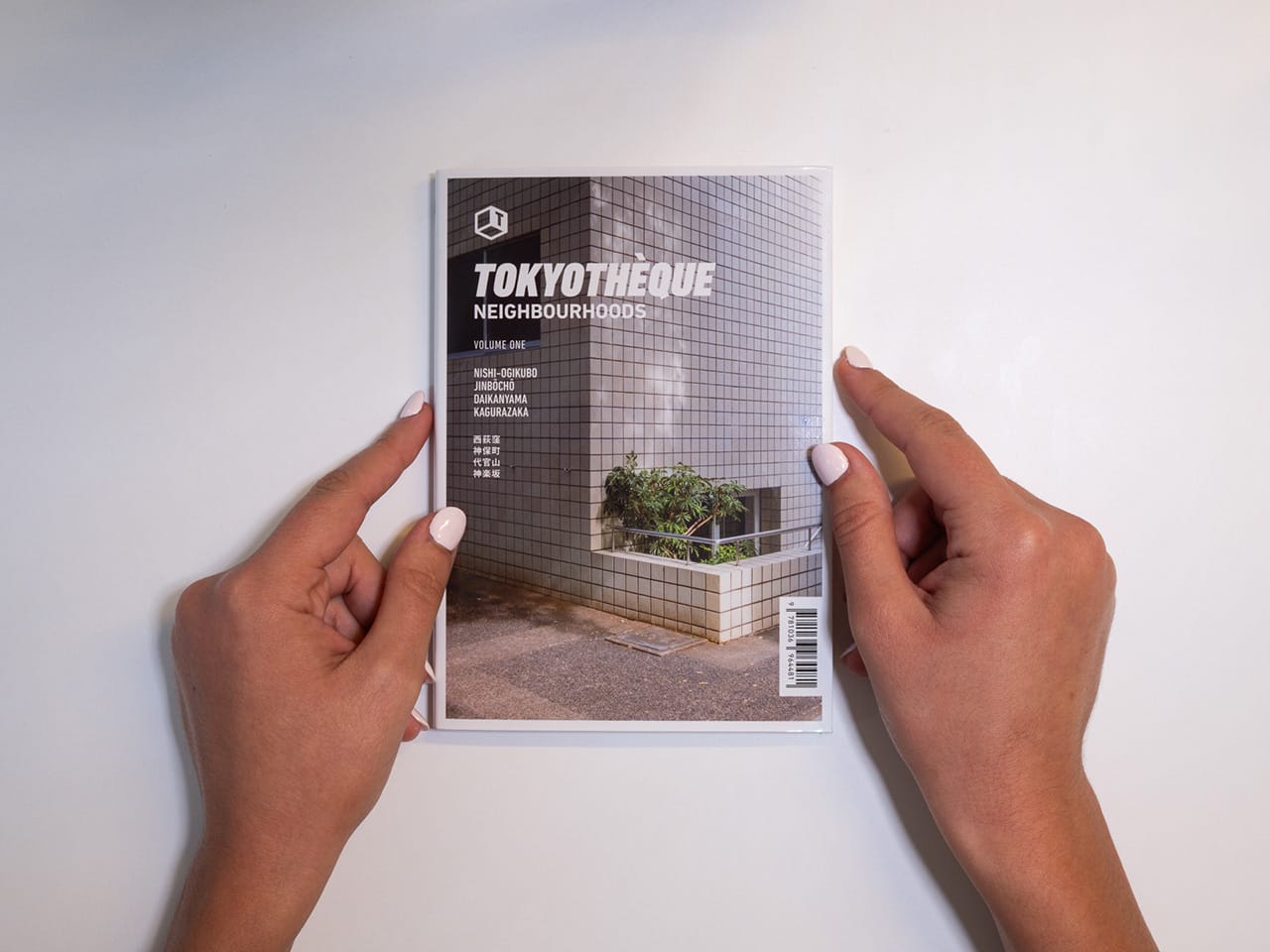
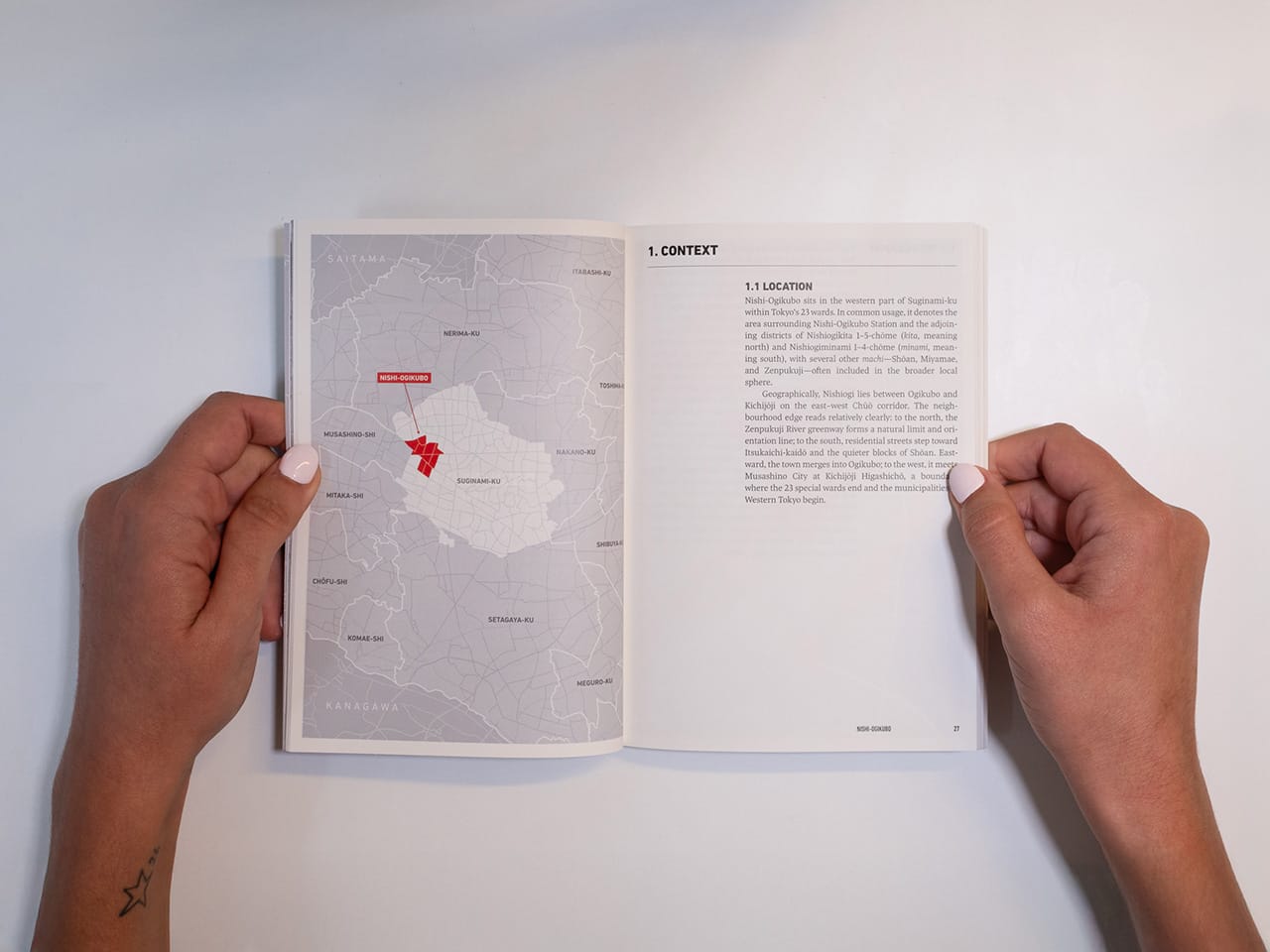
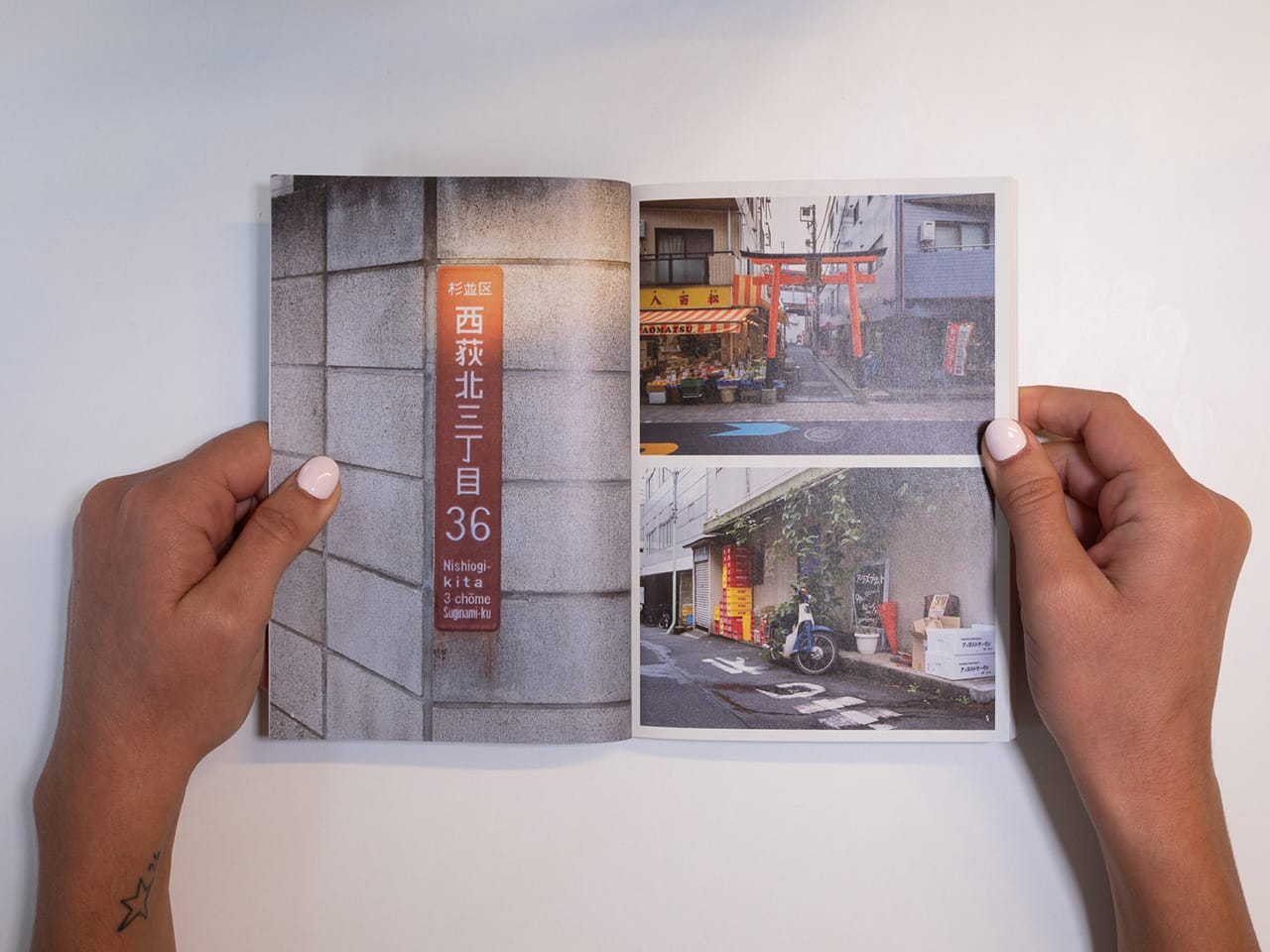
On the topic of getting down to street level, the second printing of Tokyothèque Neighbourhoods: Volume One has finally arrived in London.
Our thanks go to everyone who pre-ordered a copy and made this printing possible. Pre-orders will begin shipping on Monday.
For those still intending to pick one up, it is now available for immediate dispatch.