
Lift the receiver. Insert a telephone card or deposit coins. Then you will hear a dial tone. Dial a number.
— NTT West, Types of Public Telephones and How to Use Them
I listened as my friend recalled a long-distance relationship. To speak with her Parisian boyfriend, she would leave her house in an English town and walk to the phone box, never knowing whether it would be free or how long she might have to wait. Once inside, she would stand shivering through the call. In a teenage romance, a phone call is often less about exchanging information than just being connected. Their conversations stretched on, limited only by the balance on a telephone card. She remembered being unable even to sit down, tethered to the phone by the receiver’s short, metal-encased cable.
I compare it with the scene before me this afternoon. A teenager has just walked in mid-call, wireless earphones in, ordering lunch and coffee while keeping the person on the other end of the line updated as she goes. Sitting opposite me, she eats without ending the call, entirely hands-free. There are long silences and occasional switches to video to see what her friend is trying on. From one perspective, we take connection wherever we go; from another, it follows us.
Paris’s last conventional public telephone box, on Rue Ordener in the 18th arrondissement, was removed in June 2017, consigning the telephone box romance to the city’s past. Similar removals have taken place around the world. New York removed the last payphone in its citywide replacement programme in May 2022, retaining just four traditional booths. In Berlin, Deutsche Telekom disconnected its remaining public telephones in January 2023.
I am not nostalgic for the physical act of using a payphone. Still, I find myself looking back on the social conditions in which they existed with some longing. For a relatively brief period, the extraordinary reach of telephone communication was widely accessible, but remained tied to particular places. Between those places, you were beyond reach by phone. There was the long-distance call, and then the uninterrupted walk home.
Public telephones have largely disappeared from everyday urban life in many other cities, but Tokyo’s green telephones remain. Illuminated at night and well maintained, they can still be found on street corners, along major thoroughfares and in railway stations, hospitals and other public facilities.
Japan’s public telephone network peaked at around 930,000 instruments in the mid-1980s, before the spread of mobile phones accelerated its decline. By March 2026, the nationwide total had fallen to approximately 83,500, including just over 9,200 across Tokyo Metropolis. Even so, the network remains far from disappearing entirely.
In Communicating the City, urban communications scholar Matthew Matsaganis observes that, like other forms of infrastructure, communications networks generally go unnoticed until something disrupts their functioning, exposing our dependence on them. Ordinarily invisible, the cables, masts, exchanges and servers that facilitate everyday communication become apparent when something fails.
Following the Great East Japan Earthquake on 11 March 2011, mobile networks became congested and long queues formed at public telephones across Tokyo. That day, NTT East made calls from its public telephones free across all 17 prefectures in its service area. Thousands of additional telephones offering free calls were installed at evacuation shelters and other locations in the following weeks. The disaster brought renewed attention to the value of public telephones, and in June 2012, both regional NTT operators published detailed maps of their locations, allowing people to identify an alternative before an emergency.
Even as their numbers continue to decline, NTT remains legally obliged under universal service rules to maintain a minimum network of public telephones across Japan, at a density of approximately one per square kilometre in urban areas. This helps explain why they remain a working feature of Japanese cities after disappearing from many others.
On Tokyo’s streets, each green telephone is an open line to history. Listening in makes visible the gradual transformations of everyday life that might otherwise escape our notice, without waiting for the next crisis. You only have to lift the receiver.
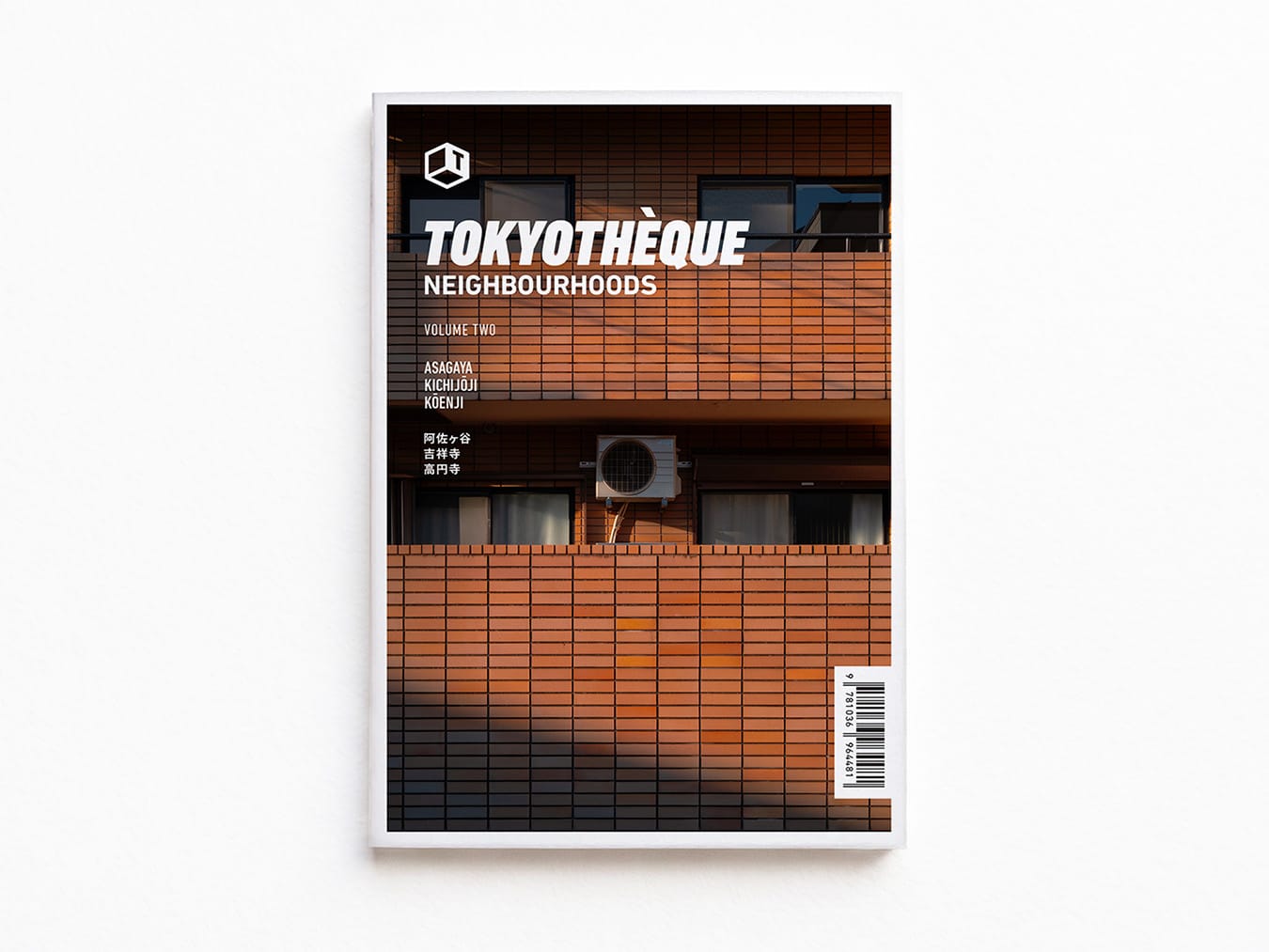
The final day to pre-order a signed and numbered copy of Tokyothèque Neighbourhoods: Volume Two is tomorrow, Sunday, 25 October.
The book is now off the press and en route to London. We will begin packing and dispatching orders as soon as the shipment arrives.
An Exchange of Centuries
When commercial telephone service began on 16 December 1890, it had just 155 subscribers in Tokyo and 42 in Yokohama. Businesses, government offices and wealthy individuals used it to coordinate their activities across the two modernising cities. Sixteen public calling facilities also opened inside telegraph and telephone offices, allowing those without a subscription to use the network. The telephone was publicly accessible, but its place in everyday urban life was not yet established.
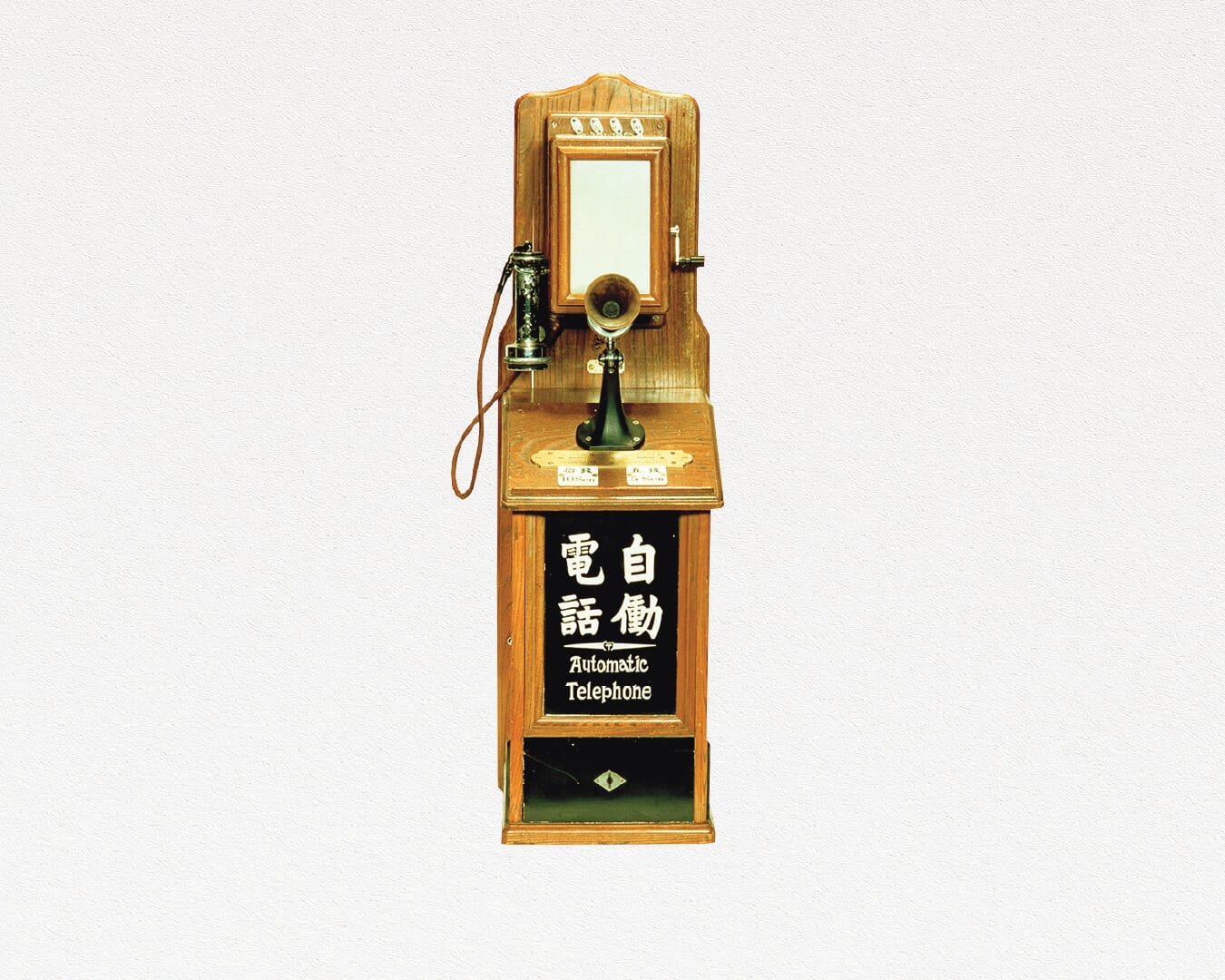
Public telephones appeared at Ueno and Shinbashi railway stations on 11 September 1900. The following month, a conspicuous white-painted, hexagonal telephone booth was erected beside Kyōbashi Bridge. Telephone access was becoming part of the streetscape, extending beyond the offices that administered the service. These early instruments were known as jidō denwa, or ‘automatic telephones’.
Jidō denwa were automatic in name only. Callers still needed an operator to connect their calls. The earliest magneto models required callers to turn a hand crank to signal the exchange, then insert payment into separate slots: a 5-sen coin struck a gong, a 10-sen coin a spiral-shaped bell. The operator confirmed payment by listening for the sound of each. The common-battery telephone, introduced in 1903, eliminated the crank but retained the operator. It would remain the standard model for almost fifty years.
By the end of the Meiji period in 1912, around 200 red-painted hexagonal booths stood across Japan, with 463 street public telephones nationwide. For most people without a private telephone, they offered an alternative to visiting a telephone office or borrowing a neighbour’s. Public telephones were becoming a recognisable feature of modern urban life, but making a call still meant finding one, summoning an operator and providing audible proof of payment.
The Great Kantō Earthquake of 1923 destroyed much of Tokyo’s telephone network, interrupting its gradual expansion. Reconstruction brought automatic exchanges, allowing some subscribers to dial without an operator from 1926. Progress was uneven, though. Trials of automatic public telephones in the early 1930s foundered on unreliable coin-collection mechanisms, leaving callers dependent on an operator.
War placed new demands on Japan’s telephone network, with military and industrial connections taking priority as ordinary telephone use was restricted. The war also brought destruction on a national scale. By 1945, roughly half of Japan’s subscriber telephones had been lost. After half a century of gradual expansion into everyday urban life, much of the network would have to be rebuilt.
The Age of Automation
Makeshift public telephone booths appeared in bomb-damaged cities, their small windows designed to conserve scarce glass. As Japan recovered from the war, shops and factories reopened, commerce revived and the need to coordinate activity across distances grew. Demand for telephone connections soon exceeded the capacity of the damaged network.
Home telephones remained far from commonplace, so making a call still meant finding a public telephone or borrowing a neighbour’s. A domestic long-distance call, meanwhile, could involve waiting more than two hours for an operator to establish the connection. Reaching someone remained an undertaking.
Coins were also scarce in postwar Japan, making payment another hurdle. Some public telephones were adapted to accept banknotes, but these could not activate the bells through which operators confirmed payment. Nor could the circuitry prevent an unpaid call, so callers were simply taken at their word. Initially, the honour system appeared to work, but as word spread that calls could be made without paying, payments declined.
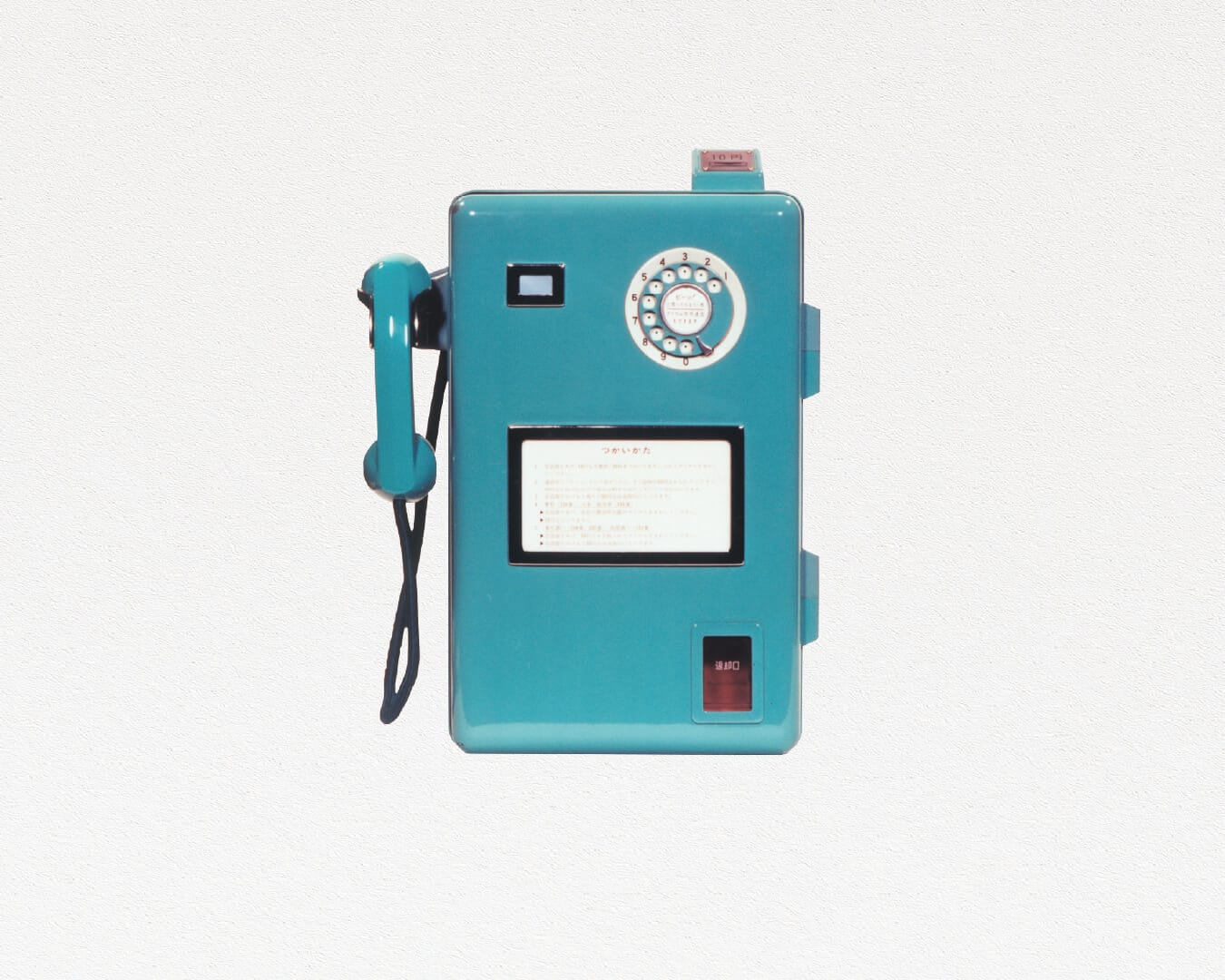
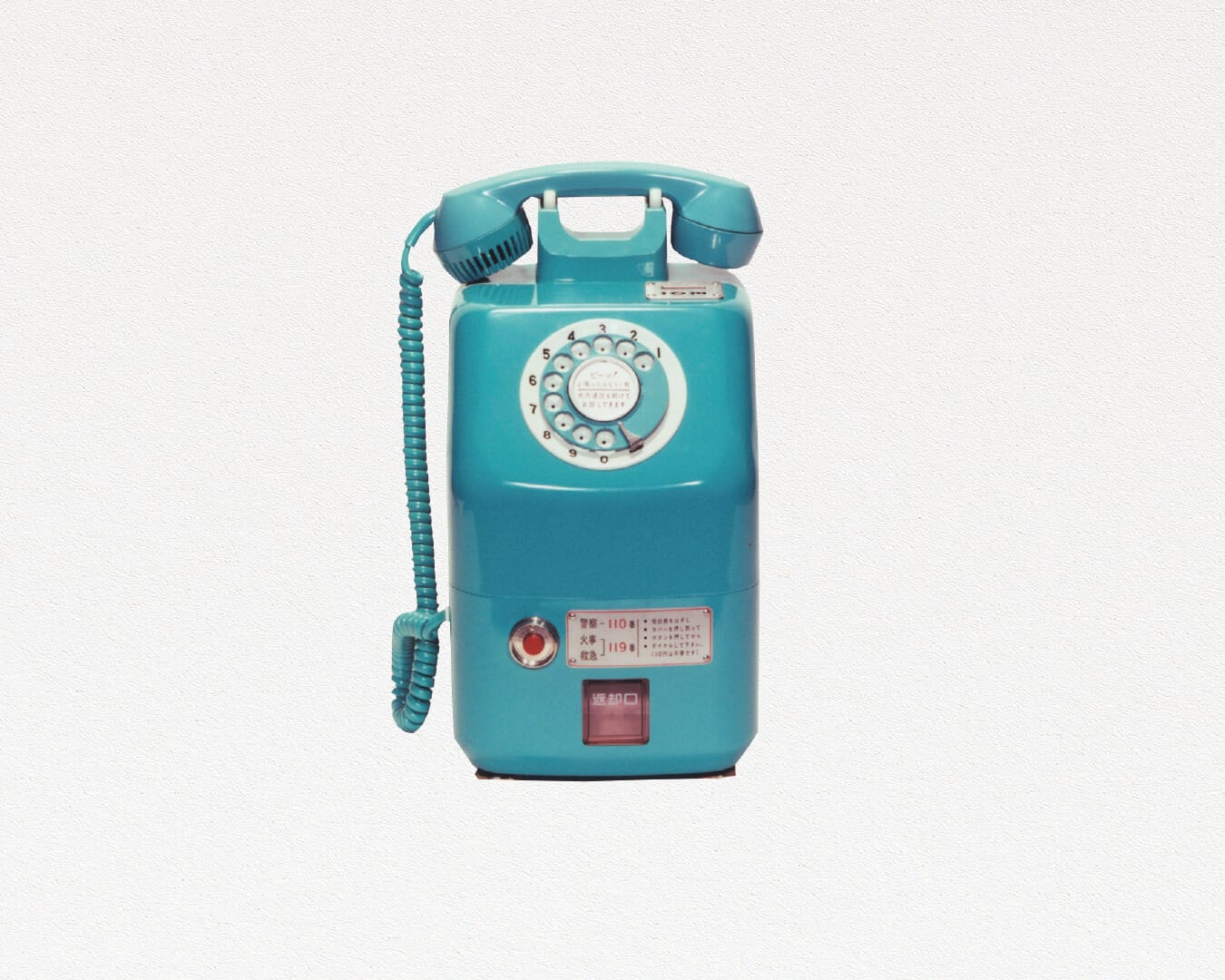
By 1951, public telephones in booths had gained automatic dialling, allowing callers to make local calls without an operator. As ¥10 coins entered wider circulation, the blue telephone was introduced in 1953, equipped to accept the denomination.
Problems collecting payment, however, persisted. Callers could dial before paying and had ten seconds after the recipient answered to deposit a coin. This was enough time to exchange a few words and hang up without paying—a small act of pilferage made possible by the mechanism intended to prevent it.
In December 1955, prepayment models introduced the system that would become standard: insert a coin first, and receive it back if the call did not connect. The tasks of establishing a connection and confirming payment, once divided between caller and operator, were gradually being taken over by the telephone itself. A local call that had once required human intervention could now be made alone.
The Shopfront Network
Finding a telephone remained a challenge, and street booths alone could not meet demand. By enlisting shopkeepers, the telecommunications authorities could extend the public network into ordinary businesses, making telephones available in places people already frequented.
From November 1951, shopkeepers could make their own telephones available for public use. The following month, a second scheme allowed them to host telephones supplied by the telecommunications authorities, overseeing their use and collecting payment. When the Nippon Telegraph and Telephone Public Corporation was established in August 1952, both arrangements became part of its wider effort to address the nationwide telephone shortage.
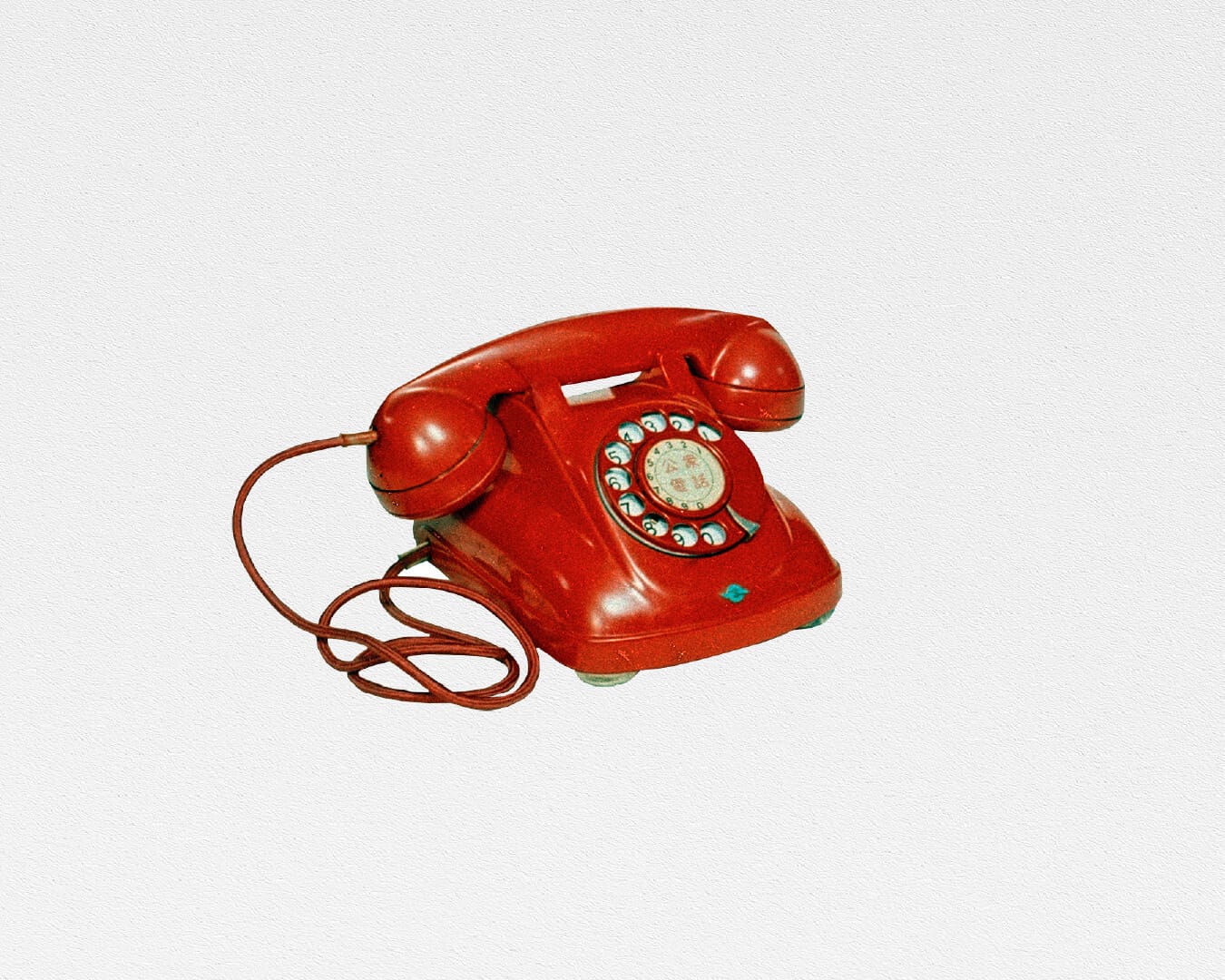
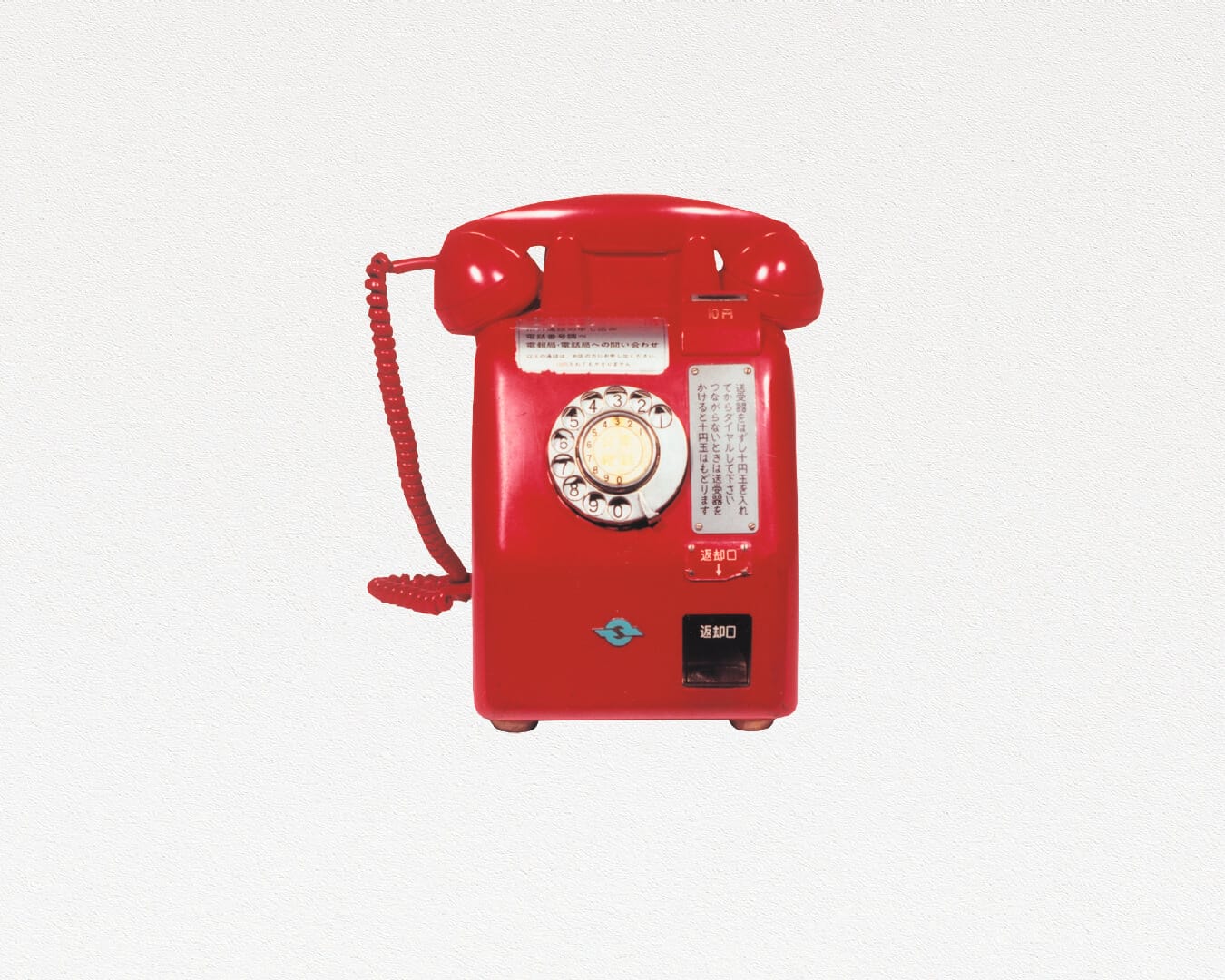
A telephone at a shopfront needed to announce its availability for public rather than private use. From August 1953, shopkeepers were supplied with red telephones, conspicuous to passers-by. In November 1954, a coin-operated model followed, nicknamed the daruma for its resemblance to the traditional Japanese good-luck doll. The first was installed in Shinjuku. Later red models can still occasionally be found outside Tokyo’s older kissaten.
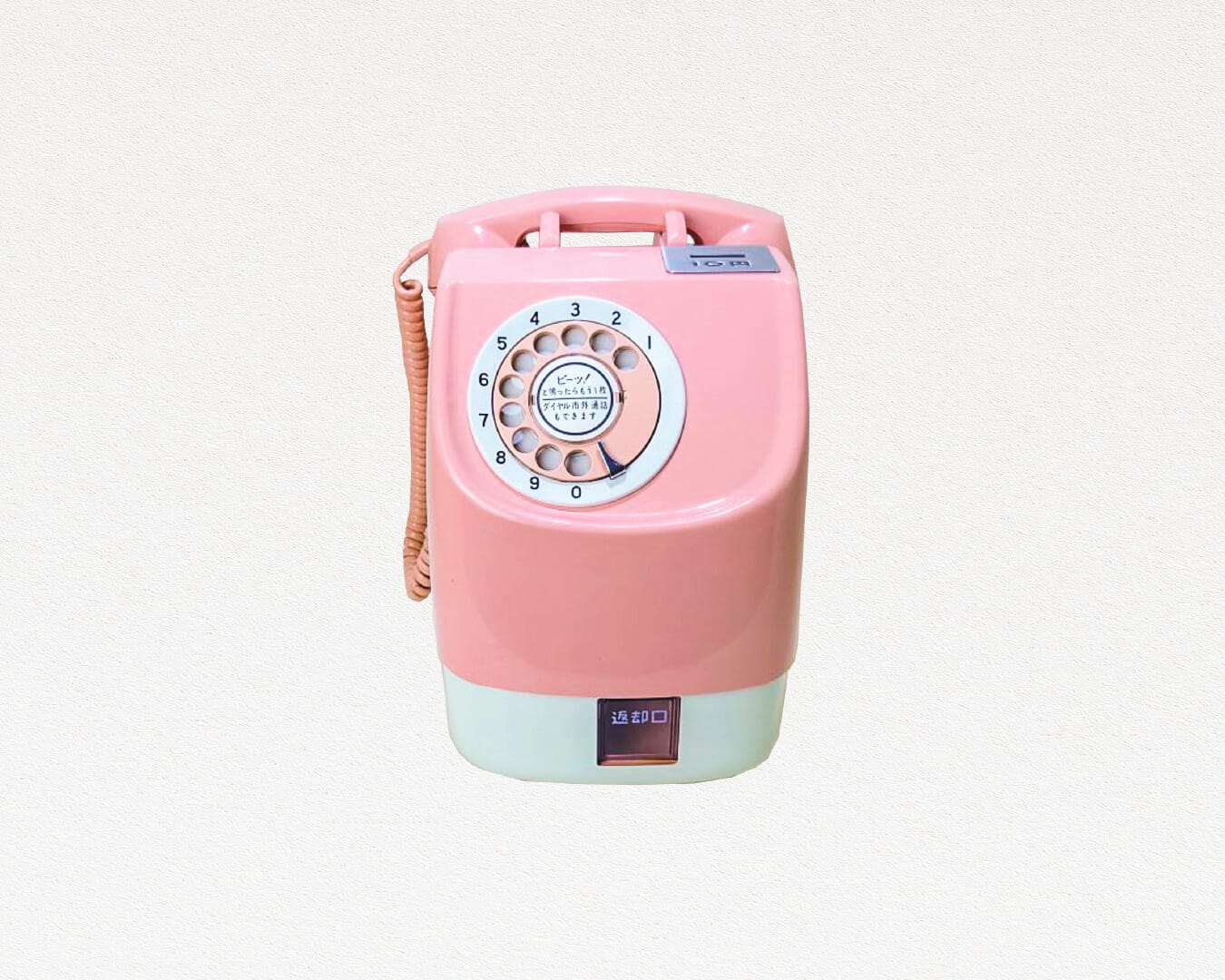
The pink telephone, introduced around 1960, allowed private telephone lines to serve as coin-operated public telephones. Unlike the red shopfront models, these could be installed inside businesses at the subscriber’s request. Making a domestic long-distance call required a key held by the proprietor.
Telephones could now be found where people shopped and gathered, rather than in places they had to visit specifically to make a call. But access still depended on where a telephone stood, who controlled it and whether the premises were open.

A Moving Story
By the mid-1950s, Japan was entering a period of rapid economic growth. People were leaving the countryside for work in expanding industrial cities, while rising incomes strengthened the domestic market. Goods and people were moving over greater distances, increasing the need for long-distance communication.
The private railway operator Kintetsu introduced an onboard public telephone service in 1957, followed by Japanese National Railways in 1960. In June 1965, the Tōkaidō Shinkansen also received public telephone service. Few things say ‘economic miracle’ more than a long-distance call aboard a high-speed bullet train. The telephone call was now in motion.
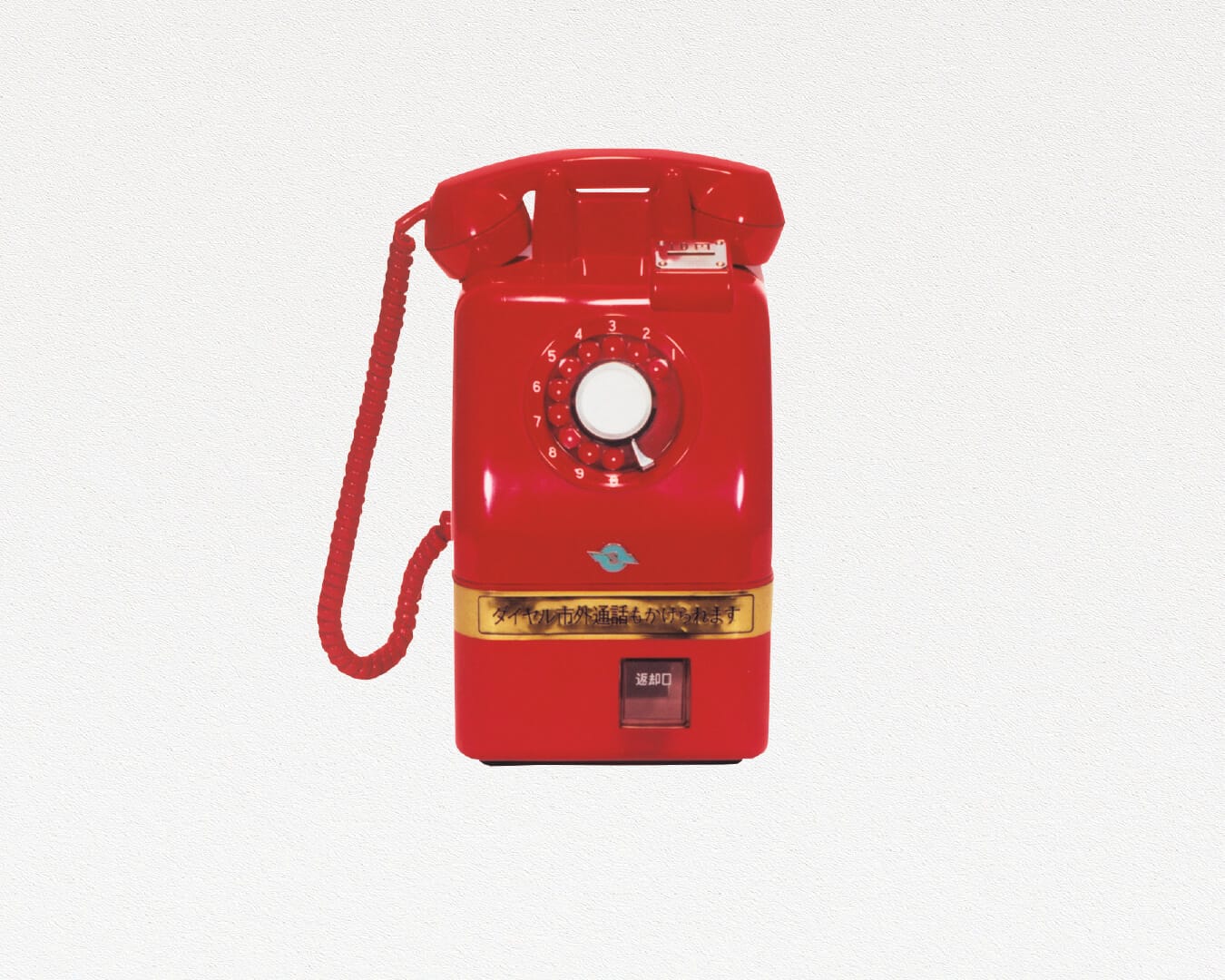
Back on the street, long-distance calls were becoming more accessible. The large red telephone, introduced in 1966 after trials at Tokyo Station, could accept six ¥10 coins at once, allowing longer, more expensive conversations. A gold band distinguished it from earlier models. Shopkeepers often brought these telephones indoors after closing time, leaving them unavailable at night.
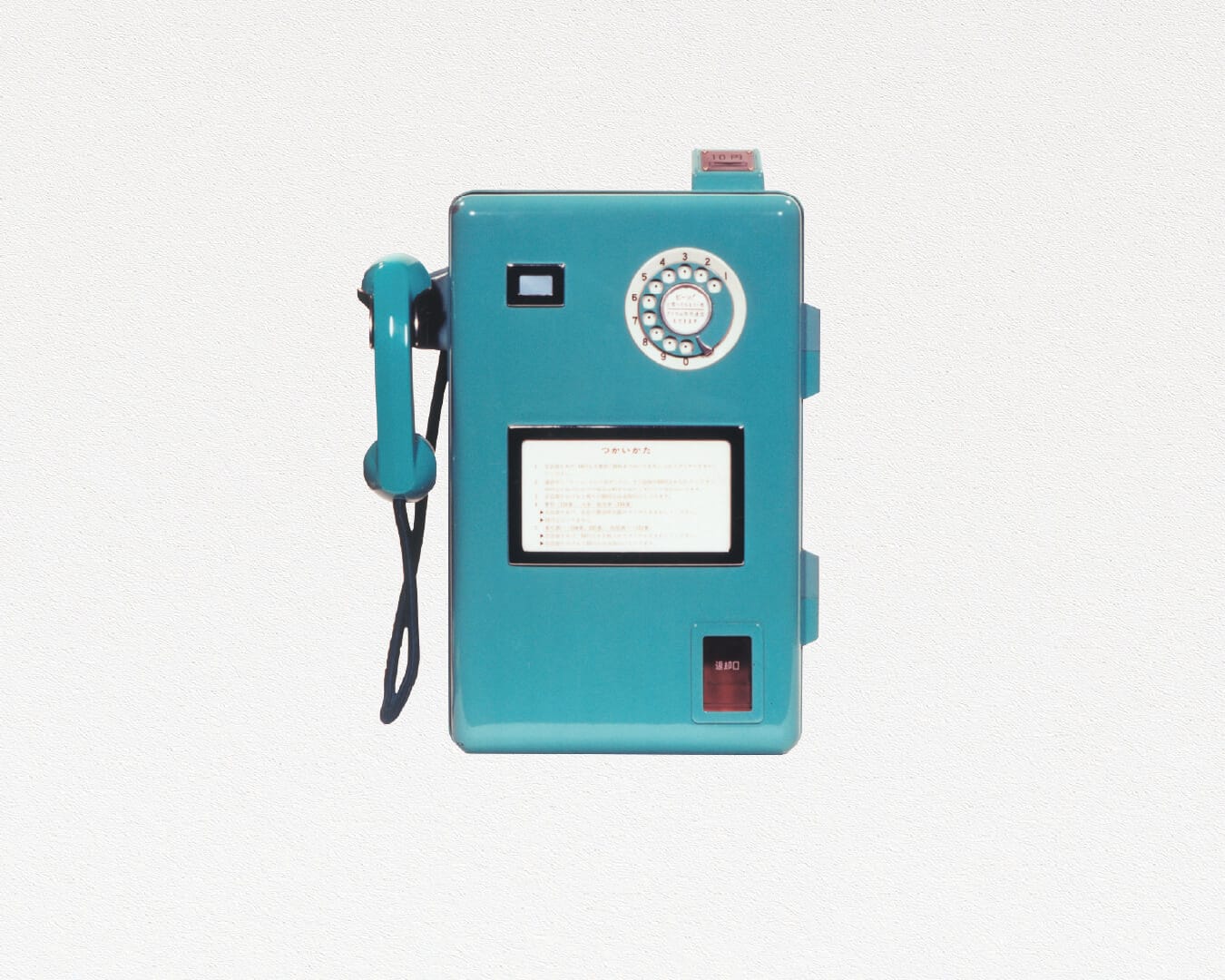
Public telephone booths had long stood on street corners and outside stations, but their blue telephones lacked the long-distance dialling capabilities of the newer red models. Introduced in 1968, the large blue telephone brought these capabilities to the booths, accepting up to ten ¥10 coins at once. More of the country was now within reach from a street corner, day or night.
Modern glass-sided telephone booths were trialled near venues for the 1964 Tokyo Olympics and adopted widely from 1969. The enclosure offered some separation from the street without entirely concealing the caller. Passers-by could see whether a telephone was occupied.
By the late 1960s, lengthy conversations could leave queues forming outside public telephone booths. The desire to spend time with someone elsewhere, familiar from my friend’s teenage calls, was becoming apparent. To discourage prolonged use, NTT began introducing a three-minute limit on local public telephone calls around 1970, with a warning chime before disconnection. However distant the voice at the other end, someone else might be waiting just beyond the glass.
Towards an Invisible Infrastructure
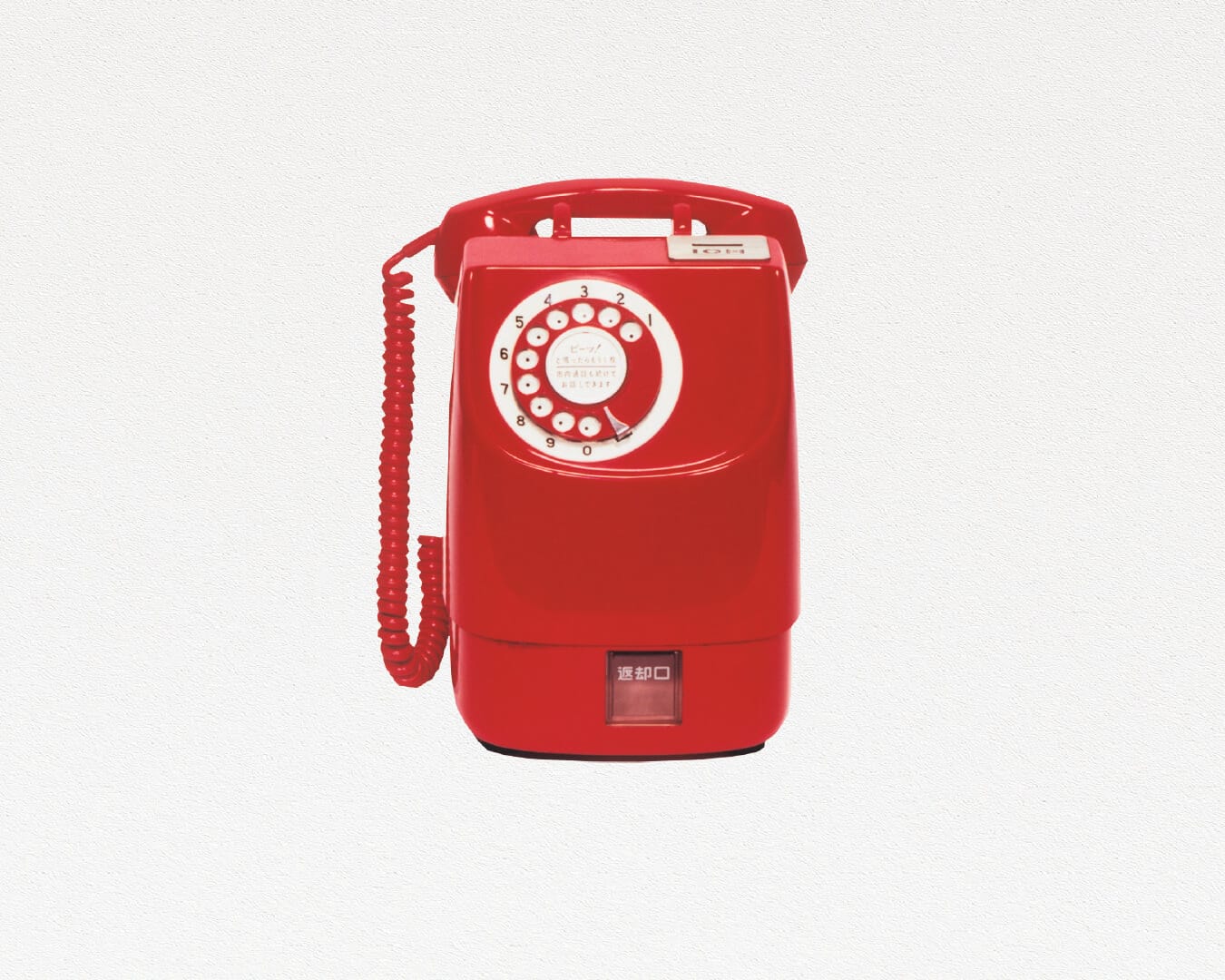
By the 1970s, improvements to public telephones increasingly addressed the smaller inconveniences of an established service. The redesigned red telephone of 1971 was 3 kg lighter, making it easier for shopkeepers to carry indoors at closing time. The blue telephone had already made overnight calls possible, but its full-sized booth was becoming harder to accommodate as road traffic increased. In 1973, a compact blue model could be installed in a small outdoor cabinet, maintaining round-the-clock access while taking up less space. Progress was increasingly measured in metric units.
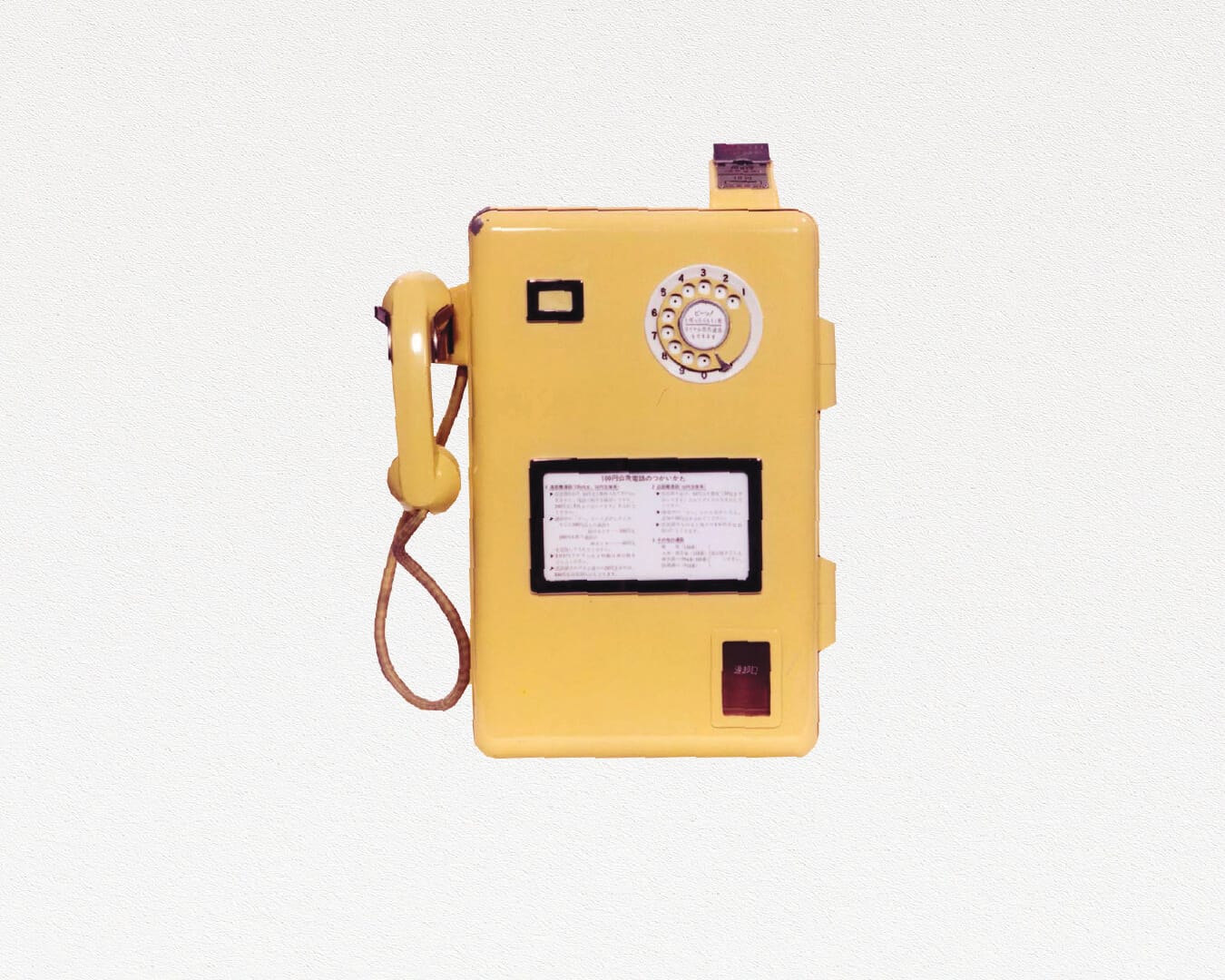
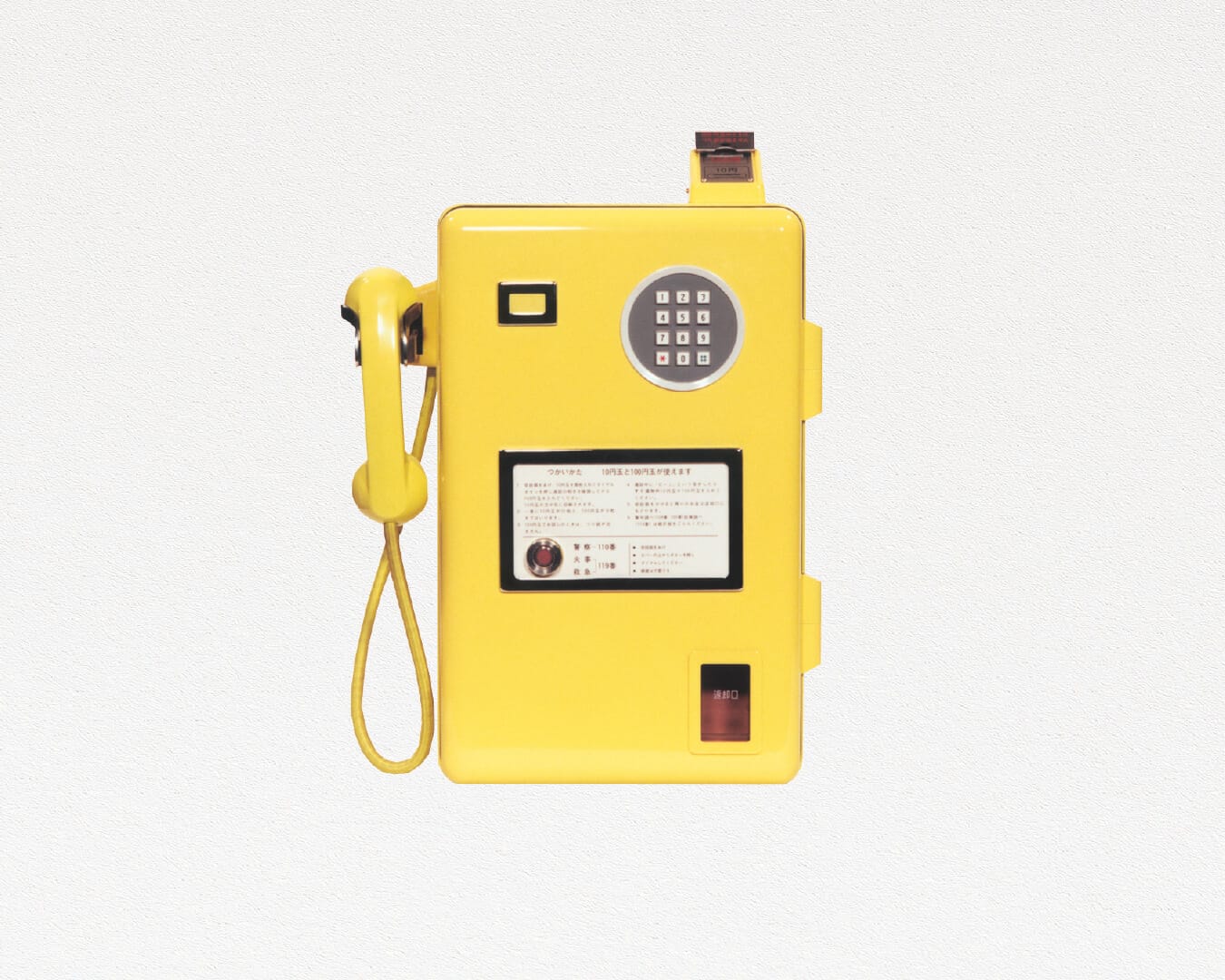
In 1972, the three-minute cut-off for local public calls was abolished, allowing callers to continue by inserting more coins. The yellow telephone, introduced that December, accepted both ¥100 and ¥10 coins, reducing the need for repeated payments and the warning sounds that accompanied them. The telephone gave no change, so callers who finished before using the full value of a ¥100 coin lost the remainder. In September 1975 a push-button version was introduced, replacing the rotary dial of the existing yellow telephone with a keypad. The design still had its shortcomings, but even in bright yellow, the public telephone was becoming part of the everyday streetscape.
The pink telephone was changing indoors, too. A larger model introduced in 1972 adopted the rounded form of the red telephone redesigned the previous year. Like earlier pink models, it operated on an ordinary private subscriber line, collecting ¥10 coins according to the duration of each call. Its distinctive form became a familiar part of the furnishings in Japan’s coffee shops. Some can still be found on the counters and in the entryways of older kissaten.
In 1978, the public corporation cleared its backlog of applications for subscriber telephones, and nationwide automatic dialling was completed the following year. Still, having a telephone at home was of little use when out in the city. The number of public telephones continued to rise, allowing people to make calls in the intervals between home, work and elsewhere.
Connections in the Bubble
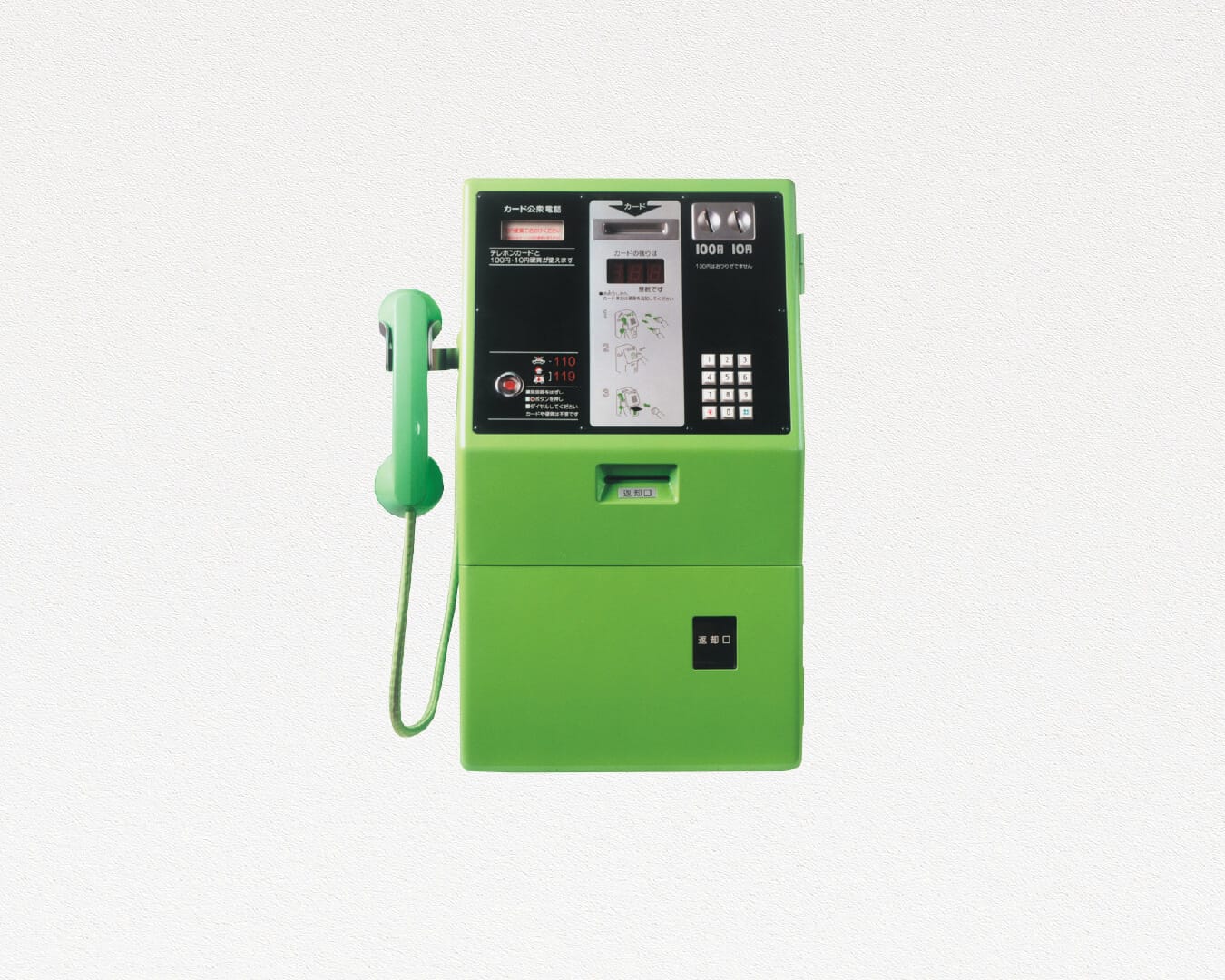
The green telephone made its debut at Sukiyabashi Park in December 1982. Equipped with a slot for a magnetic telephone card, it removed the need to keep inserting coins. A display showed the remaining balance as the conversation continued, while unused credit could be saved for another call. The earliest models accepted both cards and coins. Card-only models followed in 1984, shortly before Japan’s public telephone network reached its peak.
Telephone cards featured landscapes, celebrities and commemorative designs, and circulated as souvenirs and collectors’ items. A caller might choose a card for its image, carry it in a wallet and keep it long after its credit was spent. The telephone itself was shared, but the card could reflect something of the person using it, acquiring a significance beyond its practical function.
In 1985, the state telecommunications corporation was privatised as NTT, opening the market to competition. That year also saw the introduction of the shoulder telephone, a 3 kg portable version of the car phone that could be carried away from the vehicle. The possibility of taking a telephone wherever one went was emerging, although its weight and cost kept it beyond everyday use.
Certain kissaten effectively served as a second address for working men. If a boss was absent from the office, colleagues might telephone his regular coffee shop and ask the staff to find him. At Danwashitsu Takizawa, where coffee cost over ¥1,000, customers could stay for hours, making it a favoured gathering place for media professionals. The coffee shop offered a place to work away from the office while remaining available to colleagues, provided they knew where to call.
On the Shinkansen, a similar, if less discreet, arrangement existed. Someone calling from outside the train could dial 107, provide the operator with the train service and passenger’s name, and have an announcement made asking the passenger to come to the telephone. A private conversation thus began with a public interruption, heard by everyone within earshot.
These arrangements, cumbersome in hindsight, reveal how the boundaries of reachability were already expanding. For some, being contactable beyond the office was becoming an expectation before technology could fully accommodate it.
Losing Signal
The collapse of Japan’s asset bubble in the early 1990s marked the beginning of a prolonged period of economic weakness. Telecommunications continued to advance, however. After nearly a century of becoming a familiar fixture of urban life, the public telephone was beginning to face competition from devices people could carry with them.
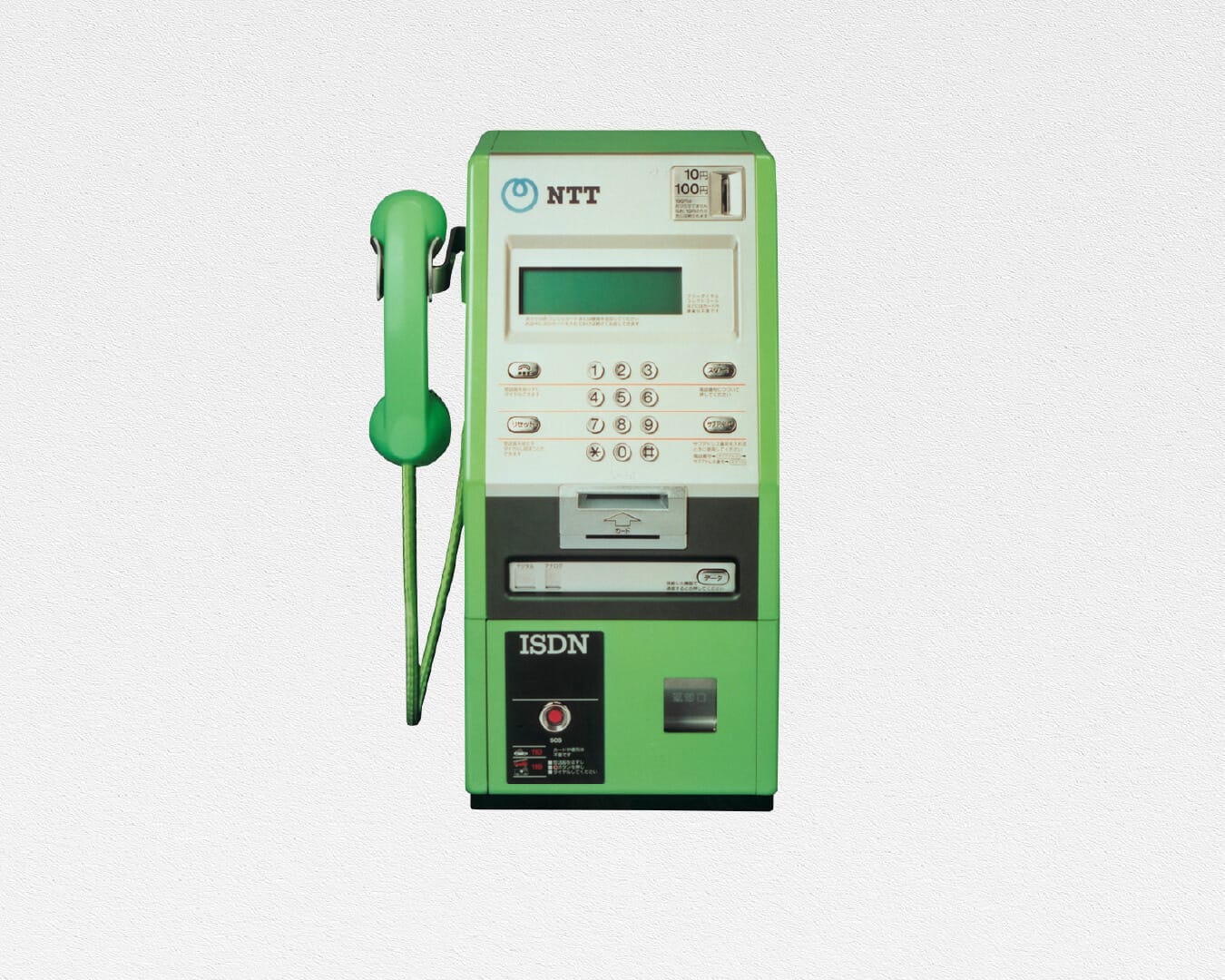
The digital public telephone introduced in March 1990 allowed compatible computers and other terminals to transmit data and images over the telephone network. Like a scene from a spy thriller, a caller could bring a laptop into the booth and jack into the network through a socket on the telephone. Subsequent grey models improved their displays, operating instructions and card security.
By the mid-1990s, the internet was beginning to reach ordinary Japanese users through telephone lines. The booth was accommodating a form of networked communication that would eventually make it less necessary.
Around the same time, pagers allowed short messages to reach someone carrying a receiver in their pocket. Sending a message, however, usually required a telephone. Young people queued at public telephones to tap out strings of numbers, developing a shorthand capable of conveying even intimate feelings: 14106, for instance, meant ‘I love you’. The telephone was no longer necessarily used for speaking. The recipient was now untethered, even if the sender was not.
Following the unwieldy shoulder telephone of 1985, mobile handsets became smaller and more affordable. In April 1991, NTT introduced its mova range, with handsets weighing around 230 g and small enough to fit into a pocket. Relatively inexpensive PHS (Personal Handy-phone System) services followed in 1995, widening access further. What had begun as an expensive business convenience was becoming an ordinary personal possession.
All the while, public telephone calls were becoming more expensive: ¥10 bought 90 seconds of local calling time from October 1993, then just one minute from April 1994. The payphone was losing its particular advantage in the intervals between places.
The Nationwide Web
In February 1999, DOCOMO launched i-mode, bringing mobile internet services into everyday use. It offered email and access to news, weather and ticket reservations. DOCOMO described the development as a shift from talking on a mobile phone to using it. Communication was becoming one of several activities available through the handset. By January 2001, i-mode had surpassed 18 million subscriptions.
Folding handsets, colour displays, downloaded ringtones and personalised screens gave this changing relationship a visible form. Where the bright colours of public telephones announced a service available to everyone, mobile handsets increasingly reflected the tastes of their owners. The novelty lay both in the device itself and in what could be done with it.
A message sent from a mobile phone did not demand the uninterrupted attention of a voice call, much less a journey to a booth. Where pagers had untethered recipients, mobile phones freed senders too.
Researchers Mizuko Ito and Daisuke Okabe documented how young Japanese people used mobile messaging to maintain intimate relationships within the constraints of home, school and public space. In one account, a teenage couple exchanged messages after parting at school, continuing through homework, dinner and television before speaking on the telephone late at night. The call had become one part of a conversation conducted in fragments throughout the day.
In March 1999, new IC-card public telephones appeared with infrared connections for compatible mobile devices. By 2005, NTT had decided to withdraw the system, citing low usage, incompatible cards and the cost of maintaining two card systems. Their presence in the history of Japan’s public telephones was brief.
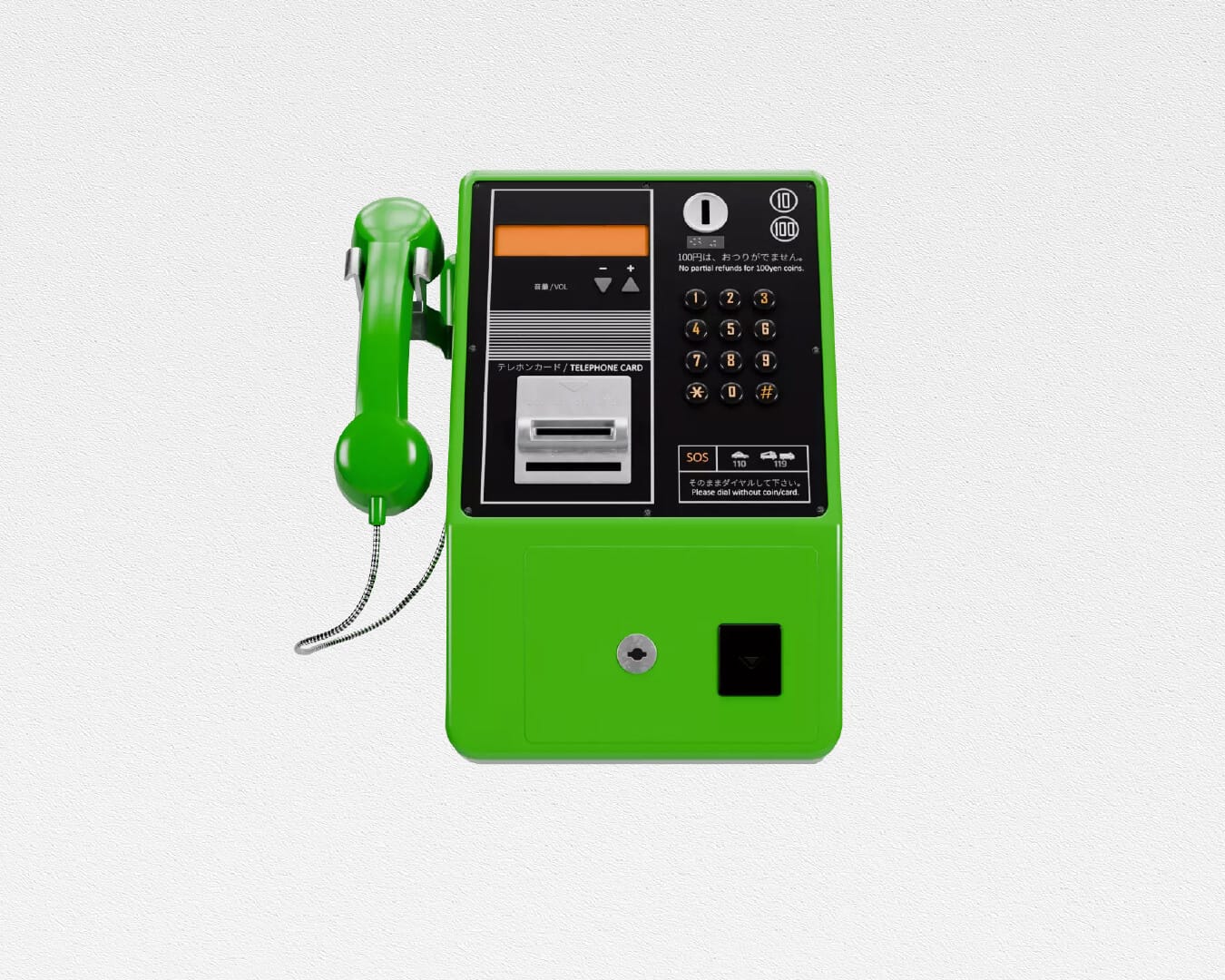
The new-style digital public telephone introduced in 2005 had large buttons, a guided coin slot and an orange-backlit display, making it easier to use. Its familiar green made it immediately recognisable. When the new-style analogue telephone arrived in 2016, it retained much the same exterior. After more than a century of changing shapes, colours and mechanisms, the Japanese public telephone had effectively reached its present-day form.
The mobile phone continued to accumulate functions that invited attention, while the public telephone was increasingly overlooked as the need to use it diminished. The green telephone could remain conspicuous on a street corner yet disappear from an urbanite’s practical understanding of the city.
Connection, Interrupted
SoftBank introduced the iPhone 3G to Japan on 11 July 2008. Japan was already accustomed to email and online services on mobile phones, rather than waiting to discover mobile internet. The iPhone combined its large touchscreen with a growing catalogue of downloadable applications, allowing it to acquire new functions long after purchase.
Then, on 11 March 2011, the apparent continuity of mobile communication was interrupted. Japan had spent more than a decade incorporating mobile internet and messaging into everyday life. People still had their phones in their hands, but could not necessarily get through. Queues at public telephones brought the older network back into view, while disrupted mobile calls exposed the infrastructure on which the seemingly self-contained devices in everyone’s pockets depended.
As service was restored, mobile communication continued its rapid expansion in Japan, as it did around the world. In October 2011, KDDI joined SoftBank in offering the iPhone. DOCOMO followed in September 2013, making the device available through all three major Japanese mobile operators.
Navigation, banking, payments, identification and access to everyday services increasingly converged on the handset. Social networks introduced new habits of engagement, with interfaces designed to encourage repeated use. The handset’s practical usefulness encouraged reliance, while the applications it carried bred new habits of attention. Each additional function increased both the frequency with which people reached for their phones and the consequences of being unable to connect.
Je Te Laisse
I think again of my friend’s teenage calls to Paris, which required a journey into the cold and, eventually, a goodbye. The teenager in the café today, in principle, never has to utter the words. Both express the same desire to feel close to someone elsewhere.
I recognise that desire when I reach for my own phone, but it is not always easy to distinguish from habit. Sometimes I am hoping to hear from someone; sometimes a notification has drawn my attention; sometimes the gesture precedes any conscious intention. We welcome each small improvement in convenience, scarcely noticing the larger changes taking place in our lives.
The telephone box had a door you could close behind you on the way out, but the smartphone offers no such boundary. Connection has become easier to maintain and harder to leave alone. And we seem to assume it will always be there.
It’s getting late here. I’ll let you go now.
AJ
The final day to pre-order a signed and numbered copy of Tokyothèque Neighbourhoods: Volume Two is tomorrow, Sunday, 25 October.
The book is now off the press and en route to London. We will begin packing and dispatching orders as soon as the shipment arrives.