
When it is time to be open, be open. When it is time to focus, focus. When it is time to rest, do just that.
Modern working life tends to organise these states around a single opposition: labour and escape from it. Within labour, rest follows focus so that work can resume; on holiday, openness and rest are combined for a limited time. It seems that openness, the state of moving outward, noticing and exploring, is never meant to coexist with work. That division has always troubled me.
I prefer to think in terms of a trinity: distinct but cyclical, almost seasonal. My ideal working life is therefore organised into complementary phases. The first is spent away from the comforts of home and out in the world: seeing, learning and working practically and physically. This open season is characterised by novelty, uncertainty and decisions made in the moment; decisions that, once acted upon, cannot simply be clicked undone.
The second phase is spent back at base: a return to routine, predictability and processing, with each day following much the same pattern. It is the longest season, and should not be mistaken for downtime. It is characterised by deliberation, technicalities and deadlines. At the workstation, we review, organise and edit the raw material gathered during the earlier phase.
The third phase is a season of intentional rest. It is also the hardest to make a reality. Responsibilities, finances and expectations leave few city dwellers able to step away from working life for any meaningful length of time. In most professions, the individual must deliberately design such a season into their life. I, for one, am still working out how.
At Tokyothèque, we are deep within phase two. The raw material from phase one is all around us: photographs, maps, notes and memories—the stuff from which guidebooks are made. The first three could, arguably, be gathered, commodified and packaged by almost anyone. But the further we move through the process, the more clearly I understand that our raison d’être lies in memory: in what we noticed, how a place felt and what stayed with us after we left.
A familiar quotation, often attributed to Maya Angelou, comes to mind:
“I’ve learned that people will forget what you said, people will forget what you did, but people will never forget how you made them feel.”
In other words, the particulars fade while the feeling remains. Transposed to the context of guide-making, we find our photographs, maps and notes most useful when they help us return to our memories and recover the essential feeling of a place.
The details are non-negotiable: where the café is, when it opens, what it serves, how it is decorated and how the coffee tastes. Yet this kind of information is available in such quantities, from so many sources, that it can be difficult to make meaningful use of. I might rather tell you that, with tired legs after a long afternoon’s walk, we came upon the café en route through a quiet neighbourhood. Its seats were mostly empty, the service curt and the coffee average, yet for 35 minutes we felt entirely at peace there.
For this kind of transmission to be useful, you need some sense that you are on the same wavelength as the person offering it. At some level, you trust that you are likely to respond similarly when you arrive. A thousand five-star reviews of a heavily touristed restaurant, left by visitors satisfied by broad appeal and culture made frictionless, tell you very little.
When we released our first guidebook at the end of last year, we did not know how many people would share our way of seeing the world. It is a nuanced approach. Yet in the weeks and months after the pre-orders went out, we began hearing from readers who had taken the book to Tokyo and found that a Tokyothèque kind of day suited their temperament and way of moving through the city.
We also heard from those of you who read it at home, as a way of being transported to Tokyo. As a teenager, travel was not in my stars financially, but guidebooks gave me a way to begin moving towards it. A 1997 edition of Lonely Planet Kyoto, which I read like a novel, still sits near my desk for reference. Beneath the larger brand, each guide’s creation was led by individual writers who knew and loved the country. The information was dense and practical, but as someone who naturally builds mental models, I found myself turning its details into a vivid picture of the place. That imagined Kyoto drew me towards my eventual arrival there years later.
Some also enjoyed Tokyothèque Neighbourhoods simply as a design object, whether as the beginning of a new collection or as a place for our work within an existing one. All of this makes the work back at base, shut away from the British summer sun, pondering pins, debating designs, arranging, sequencing and tweaking, feel worthwhile beyond the immediate act of making it.
And so, today, we are pleased to introduce our next guidebook: Tokyothèque Neighbourhoods: Volume Two.
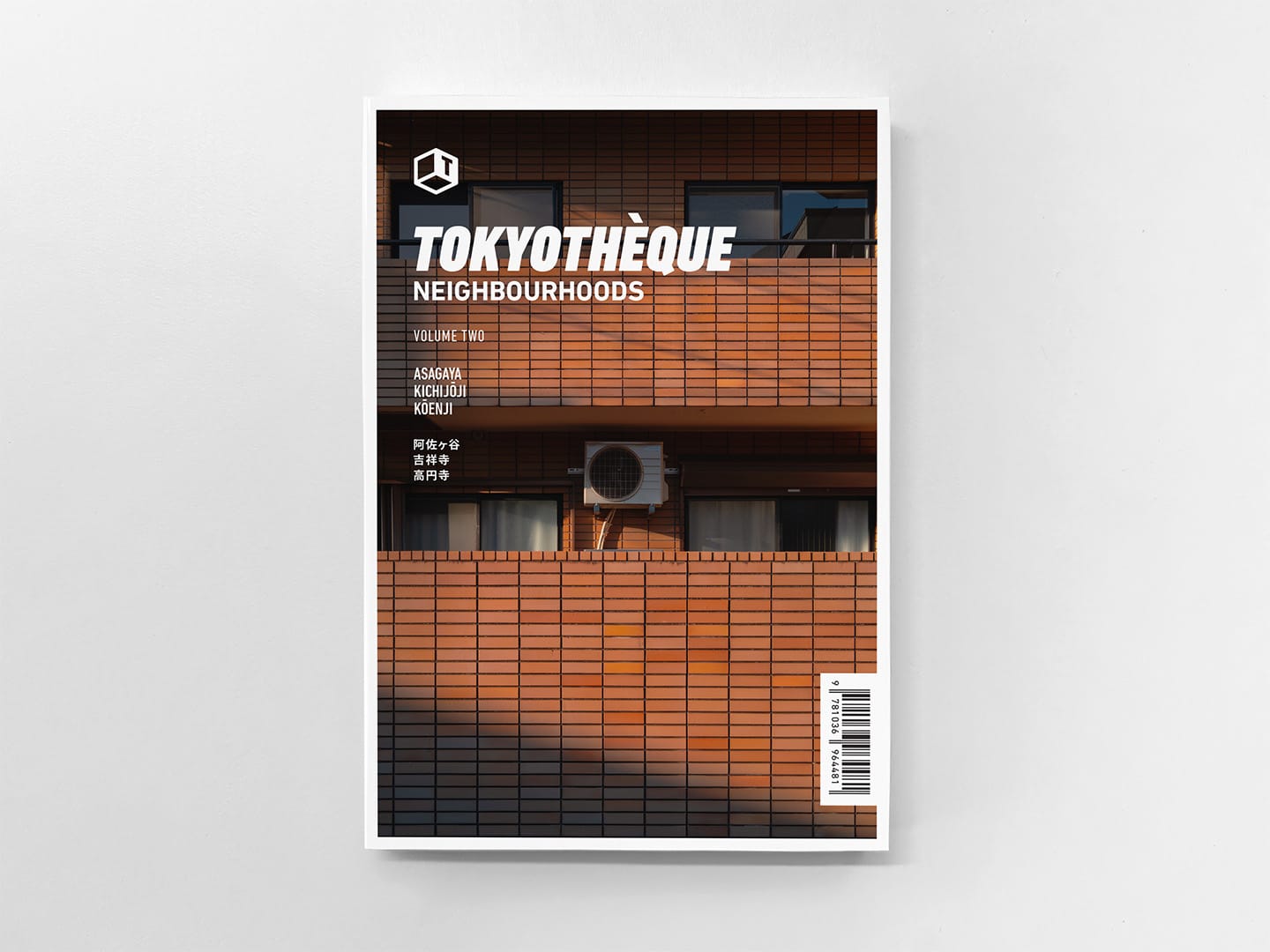
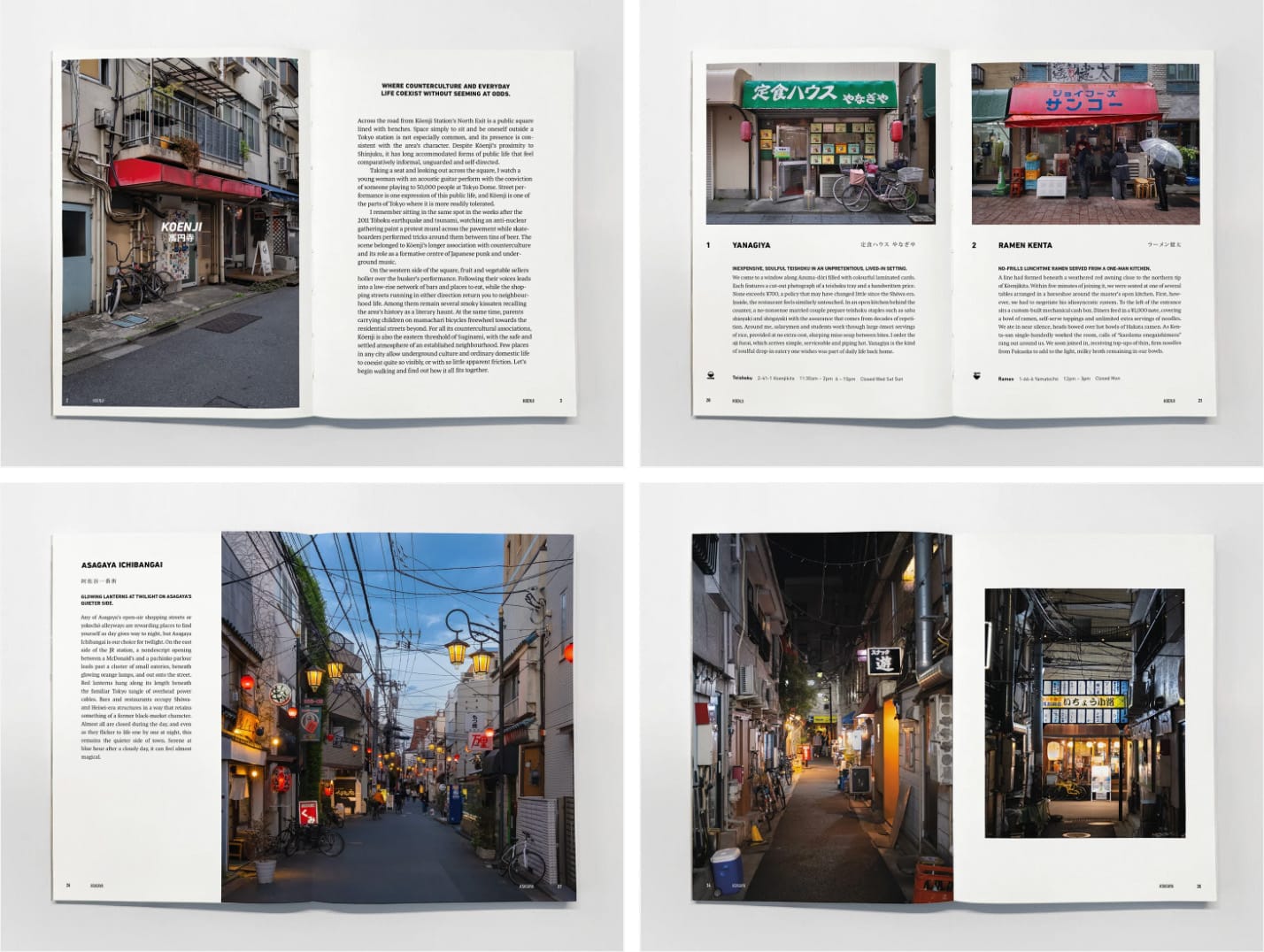
During Volume Two’s open phase, we based ourselves in Ōkubo, on the western side of Shinjuku. The neighbourhood is best known for the streets around Shin-Ōkubo Station on the Yamanote Line. Here, you emerge at street level into the thrum of K-Town, with its Korean restaurants, K-pop and cosmetics, alongside a broader mix of international cultures.
We arrived by a different route, transferring from the Narita Express to the Chūō–Sōbu Line and surfacing five minutes west at Ōkubo Station. The north exit brings you out beneath the tracks into a more relaxed scene than Shin-Ōkubo, while the quieter south exit opens onto narrow residential streets and yokocho-like lanes. The two of us wheeled our suitcases through them to a hotel several turns into the neighbourhood.
Ōkubo would not feature in the book this time, serving instead as our base for the trip. It provided an ideal gateway to the Chūō Line’s western corridor. I have always felt that an entire trip could be spent along this stretch. That is more or less what we did, concentrating on a sequence of three neighbourhoods: Kōenji, Asagaya and Kichijōji.
Each has a strong, multifaceted identity of its own, but together they share a certain low-rise western Tokyo air: refined but relaxed, residential yet culturally active, commercial yet independent. Covering these neighbourhoods left us with an accumulation of positive feelings, which continue to surface as we write and recall. As a newsletter reader, we are fairly certain you will recognise something of your own temperament in our perspective and the route through the city that the book sets out.
There are two ways to receive the new volume:
Pre-order
Pre-orders are now open, with shipping beginning on 1 October 2026. Every pre-order will be individually numbered, signed and dispatched in the order it is received. Put another way: the earlier you order, the earlier your number and place in the shipping queue.
City Walkers
From Volume Two, we are trialling a new membership system. With a City Walker subscription, you will receive two volumes each year, delivered to your door. Print editions, worldwide shipping and full digital access are all included in a single annual payment.
Pre-orders function rather like a crowdfunding campaign, helping us meet the immediate costs of production, printing and freight. Subscriptions, by contrast, represent broader backing for Tokyothèque. A City Walker subscription therefore comes with several additional privileges:
⨁ Your name in the book: with your agreement, you will be acknowledged by name in each volume released during your time as a City Walker.
⨁ Priority numbering and shipping: subscription copies will be individually numbered and signed, with priority over standard pre-orders in both numbering and dispatch.
⨁ A gift with each edition: every volume will arrive with a new item designed to accompany your travels. We do not mean to be vague about the Volume Two gift, but there are still a few details to confirm before we announce it. What we can say is that it will be practical, thoughtful, limited, Tokyothèque branded, and made in Japan.
FAQs live here. Whenever you are ready, do join us.
We cannot help looking ahead to wherever our next open season takes us, but for now we must exercise discipline and return to our layout designs. After all, when it is time to focus, focus.
Until we meet in neighbourhood Tokyo,
AJ