
The world is a huge musical composition that’s going on all the time, without a beginning and, presumably, without an ending.
– R. Murray Schafer
Schafer was the composer who popularised the concept of the soundscape. Applied to a city street, his idea might sound like this: a bicycle bell ringing against a shop announcement as a train passes overhead, with the rattle of a delivery trolley adding texture across the pavement. I hear and see cities as concentrations of these smaller, nested compositions. Architecture, infrastructure and daily life come together as a living exhibition, with the city itself as gallery.
To see a city this way requires spending time on the streets that make it up, with some attention shifted away from lists of places to visit. I have no quarrel with the practical list: the country’s prominent cities; the cities’ recognisable neighbourhoods; the neighbourhoods’ landmarks and establishments. I prefer only to place these things within a structure that lets us participate in the composition as we go.
Guidebook creation currently has our full attention on three west Tokyo neighbourhoods: Kōenji, Asagaya and Kichijōji. Alongside their independent shops, restaurants and cafés, each has an extensive network of streets where automobile traffic is absent or restricted. Without it, the human elements of the composition become easier to notice. At different points, these streets can resemble a local market, a shopping centre, a dining district or simply a route through the neighbourhood. This is the everyday shōtengai, and quite often it can seem to be all these things at once.
In Volume One, shōtengai appeared among each neighbourhood’s milestones: the points of interest around which a walking route is plotted. Kissaten, record shops, sentō, shrines, ad infinitum. As we mapped the neighbourhoods for Volume Two, however, shōtengai began to dominate the list. In our mapping, Kichijōji alone has no fewer than ten.
We felt that streets, in general, ought to be treated differently this time. Volume Two will detail each before the walk begins, then mark them by name on the map. They are, after all, something you traverse, sometimes across multiple chōme and over hundreds of metres. They belong more to the city’s connective tissue than to a collection of places that can be pinpointed.
This week, we’re taking a compressed tour of shōtengai arcades, one from each neighbourhood, to see what these streets can tell us about the city. We begin in Kōenji.
Kōenji Pal
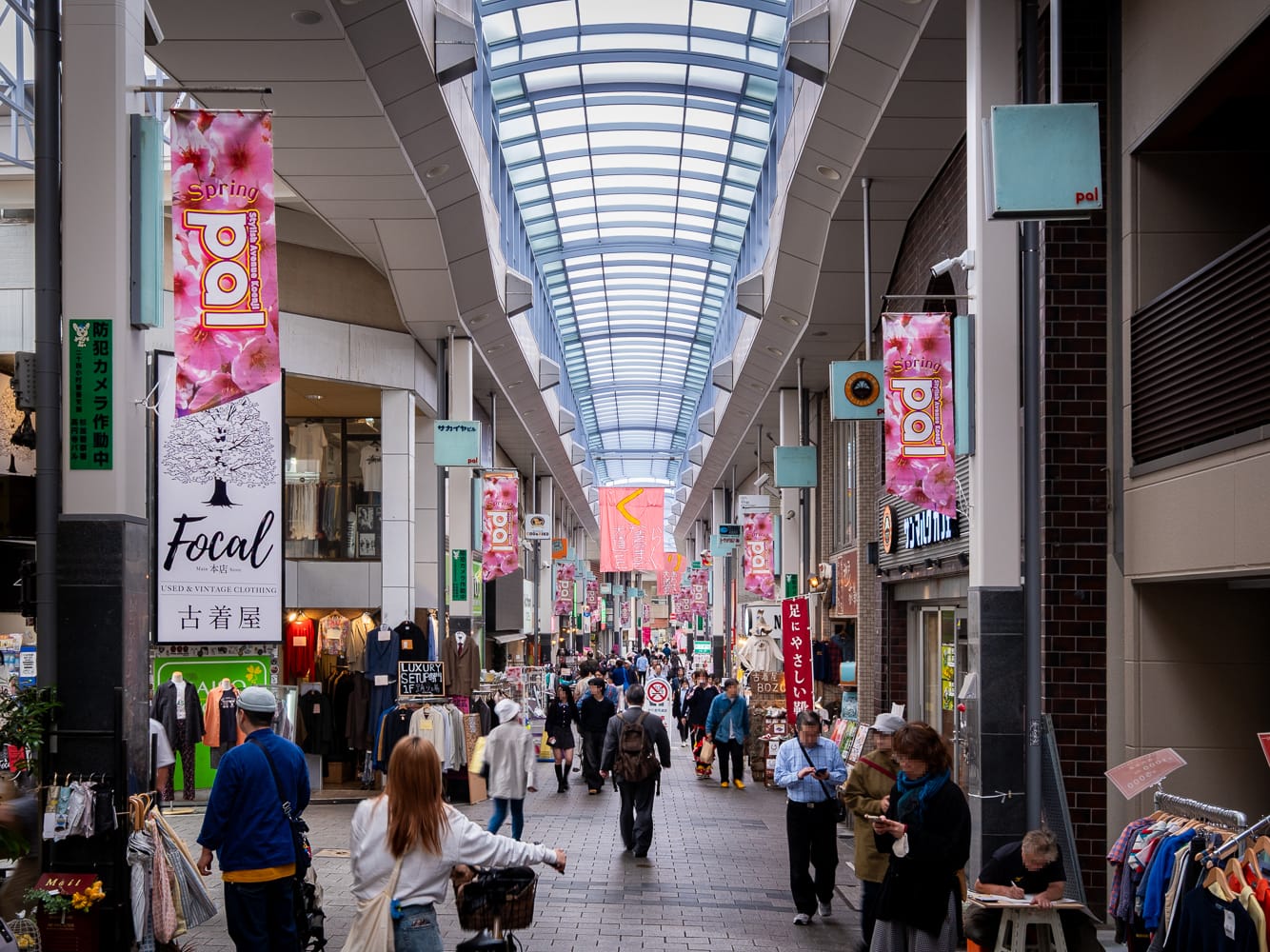
Kōenji Pal was the first shōtengai I walked through. I remember approaching from the station’s north side, with the aroma of ramen in the air and easy-listening music drifting through the PA. The murmur of shoppers filled the arcade beneath its high, glazed canopy as natural light filtered in from above. Looking through the windows and moving in and out of the shops, I sensed abundance and variety, but also a feeling of shelter—both literal and figurative. The image I’d held of Tokyo as a vast metropolis was at odds with this liveable scale.
A good many of Pal’s roughly 100 shops have lasted in the fifteen years since I first visited. Kōenji’s thrifting quarter runs along the arcade’s east side, so a large proportion of these businesses are fashion and vintage boutiques. They intermingle with record shops, variety stores and everyday necessities.
Pal eventually meets Momozonogawa Greenway, a promenade built over the old Momozono River, where the arcade’s shelter ends. From here, Kōenji Look, the next shōtengai, continues the route south. Together, the two form a kilometre-long walk to Ōme Kaidō Avenue, Kōenji’s southernmost border.
Asagaya Pearl Centre
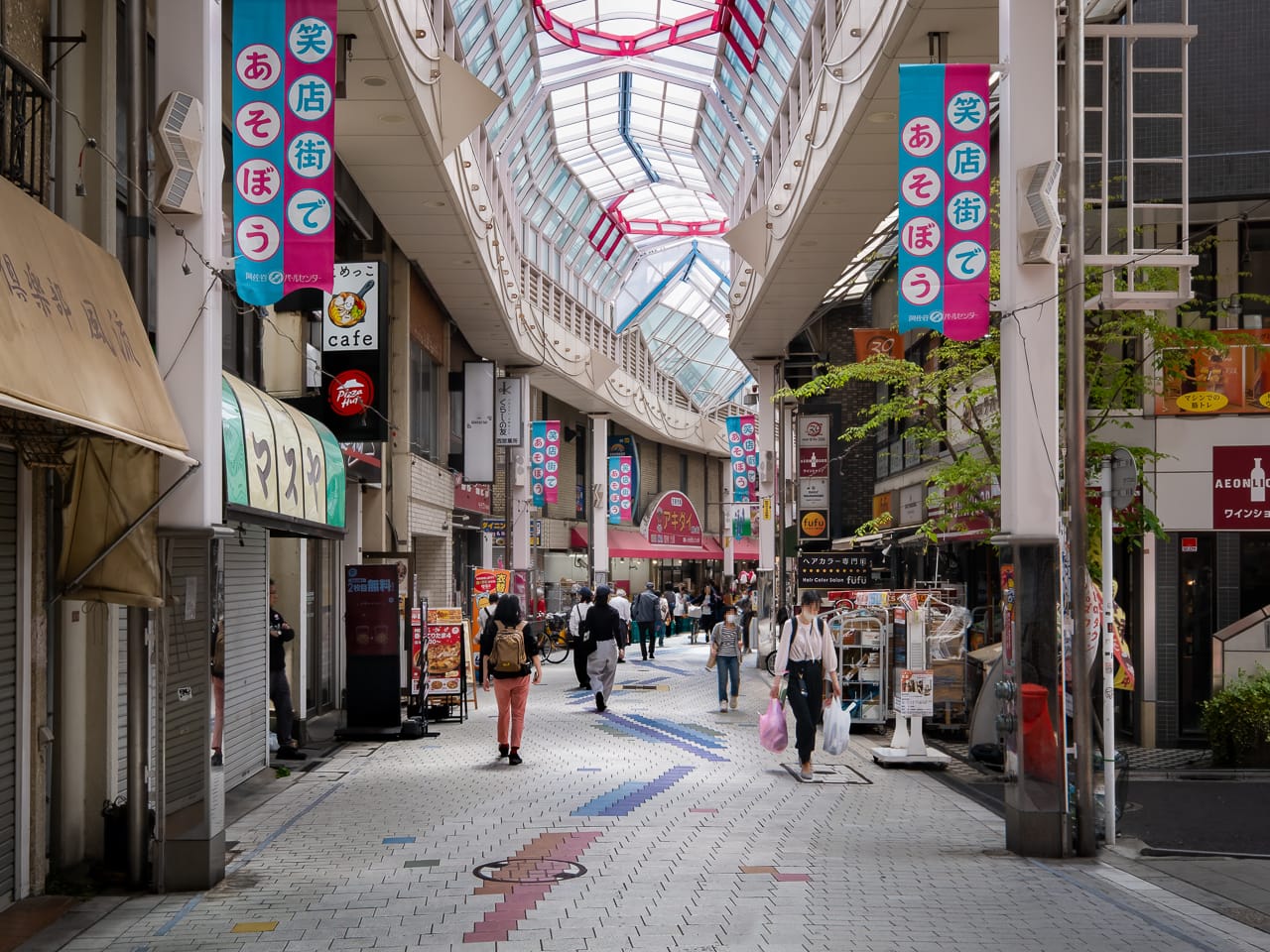
The name Pearl Centre reflects an aspiration that each of the street’s approximately 240 shops would shine like a pearl, connected like a necklace and prospering through cooperation. That idea still runs through its 700 metres. The street tends to be lively without feeling crowded, allowing you to take in Asagaya’s Shōwa-era holdovers alongside its modern conveniences at a relaxed pace.
In the Edo period, the street formed part of a pilgrimage route. Shops began to line it after Asagaya Station opened in 1922 and people relocated from central Tokyo following the Great Kantō Earthquake of 1923. After the Second World War, the street became a black market before gradually regaining its pre-war character as a shopping street. Vehicle traffic was subsequently removed, and the street came to be recognised as Tokyo’s first hokōsha tengoku, or ‘pedestrian paradise’.
From the south exit of Asagaya Station, Pearl Centre runs in an unbroken stretch to Ōme Kaidō, where we meet Minami-Asagaya Metro Station. Along the way, narrower lanes branch off to the east, offering brief detours into the residential streets and a closer look at neighbourhood life before rejoining the main route.
Kichijōji Sunroad
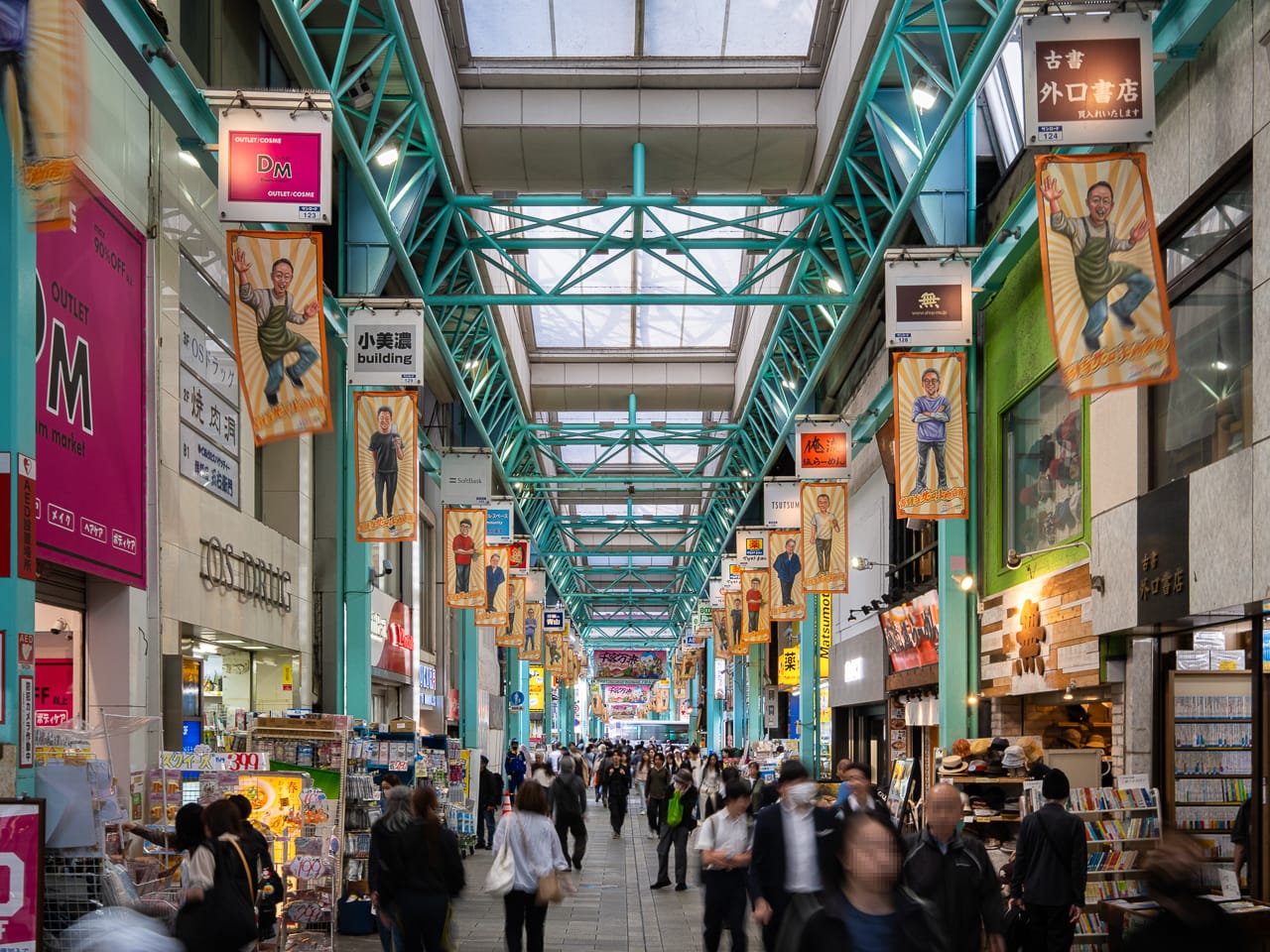
Kichijōji Sunroad is a shōtengai with virtually constant footfall, consistent with its busy location. Where Kōenji and Asagaya retain something of the scale of small towns within Suginami Ward, Kichijōji functions as a regional centre for western Tokyo, with daytime visitors arriving from both central Tokyo and the suburbs farther west.
Since its construction in 1971, Sunroad has been defined by scale. At the time, it was hailed as an arcade unrivalled in East Asia and came to represent Kichijōji’s development. Beneath sturdy turquoise girders, many of its roughly 160 shops belong to larger brands and contemporary retailers.
Still, Sunroad is the spine of Kichijōji Honchō. Over its 300 metres from Kichijōji Station, you pass Daiyagai, another large shōtengai, several smaller shopping streets extending west, and Gessōji Temple, which adjoins the arcade. Beyond its northernmost arches, the route crosses Itsukaichi Kaidō and continues into the residential streets of Kichijōji Higashichō, where the greener character of western Tokyo begins to show through.
Arriving at a busy Tokyo station, with streets leading in every direction, it can be difficult to know which way to turn. The most intriguing shōtengai, meanwhile, may sit several layers back, with only discreet signage marking their thresholds.
Our work aims to reduce that initial overwhelm, giving city walkers an optimal path through the required streets while minimising unavoidable retracing. Exit, wander and rejoin: the route and its milestones remain there to return to. The huge composition never pauses.
Until we meet beneath the covered arcade,
AJ
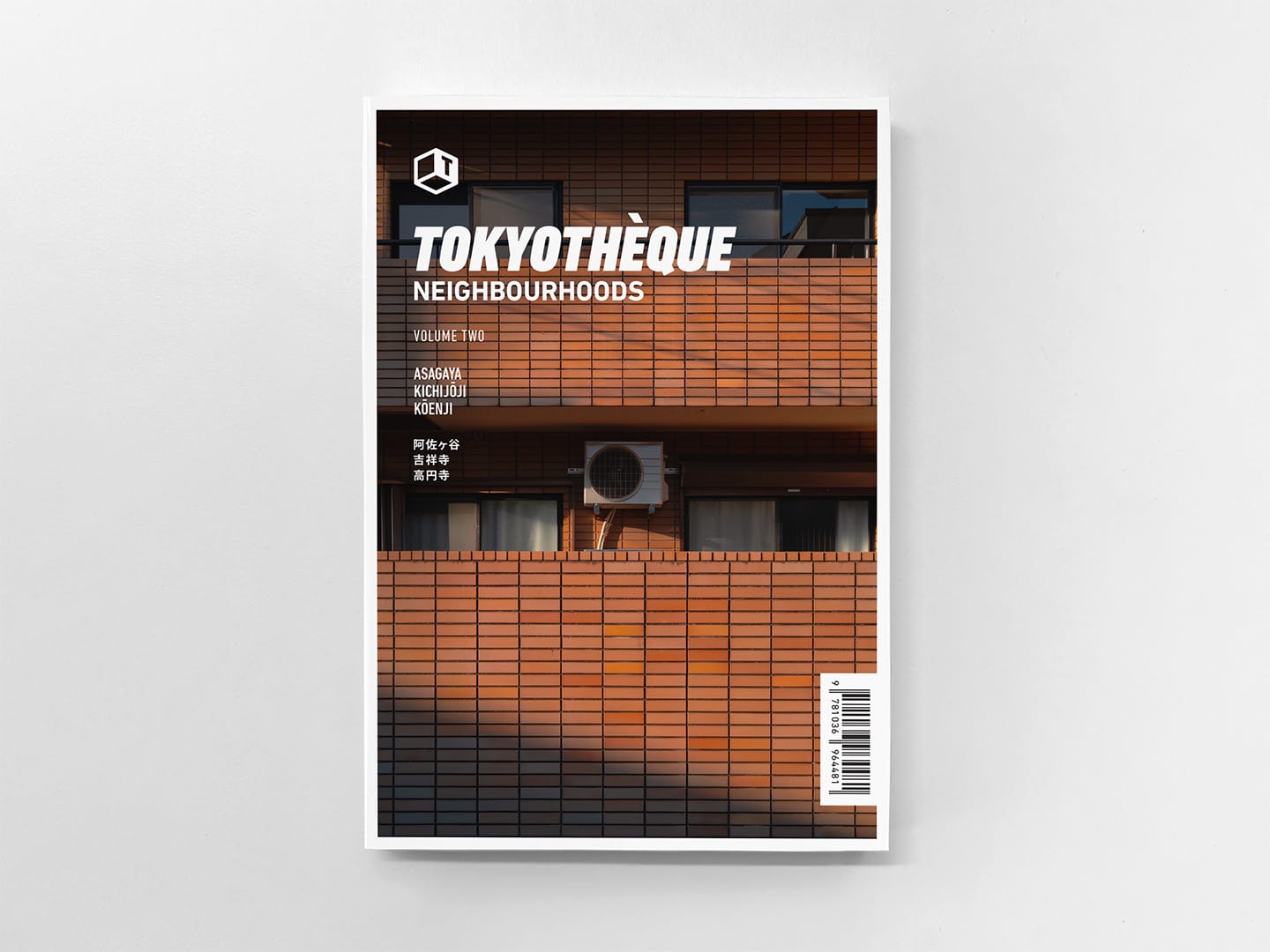
Today’s shōtengai, with their some 500 shops and distinct characters, are but three of the streets that Tokyothèque Neighbourhoods: Volume Two guides you through.
Pre-orders are now open. Shipping begins on 1 October 2026, with the earliest orders dispatched first. Every pre-order will be individually numbered and signed.
We hope you’ll join us on the book's pages, where we can elaborate further. In the meantime, it is back to laying those pages out for you.
Receive two volumes per year, complimentary shipping, and your name in the book with a City Walker subscription.